
Nowadays, the semiconductor material GaN is widely used in many electronic applications, including high-energy irradiation detectors [1]. However, its functionality is limited by material degradation during operation. To extend the applicability limits of such detectors, further research is required to improve the understanding of material interactions with high-energy particles that create structural damage.
Among various types of high-energy particles, hydrogen atoms (protons) are one of the most commonly used, and in this work the ion implantation technique was employed to generate defects in GaN using hydrogen. In addition to their availability, hydrogen atoms in the GaN crystal do not act as electrically active impurities and therefore do not introduce intentional doping; instead, they create defects by displacing host lattice atoms.
One of the most common methods for investigating irradiation-induced damage is electrical characterization of the material. Irradiation-induced defects modify the free carrier concentration and their drift mobility. The latter can be evaluated using the Hall effect method. However, the application of this method is not always straightforward and may lead to unusual results. In this study, the Hall mobility increases with irradiation dose, as shown in Fig. 1a, even though an increased defect density is generally expected to degrade carrier mobility.
The model explaining this behavior assumes that the defect generation probability depends on the pre-existing damage, leading to a non-uniform spatial distribution of defects, as illustrated in Fig. 1b. The resulting redistribution of the electric potential is responsible for the increased Hall voltage, as discussed previously [2].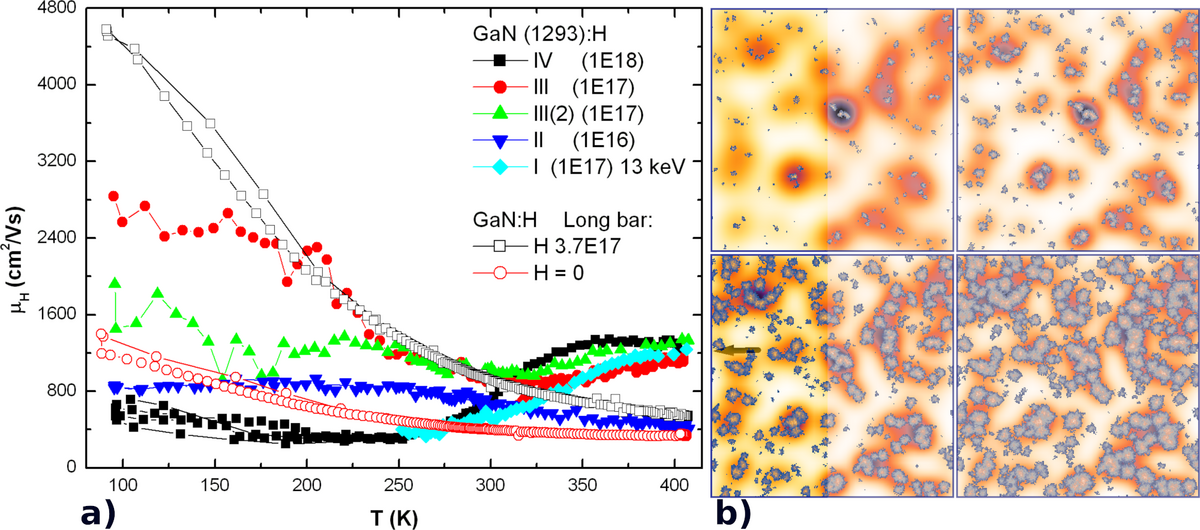
MODIFICATION OF GaN THIN LAYERS WITH HYDROGEN IMPLANTATION
Margarita Biveinytė1, Šarūnas Vaitekonis2, Vitalij Kovalevskij2, Arūnas Kadys1, Algirdas Mekys1
1 Vilnius University, Institute of Photonics and Nanotechnology, Lithuania
2 Center for Physical Science and Technology, Lithuania
Acknowledgments: This research was funded by the Research Council of Lithuania, project No S-MIP-24-81.
[1] J. Wang, P. Mulligan, L. Brillson, and L. R. Cao, “Review of using gallium nitride for ionizing radiation detection,” Appl. Phys. Rev., vol. 2, no. 3, Art. no. 031102, Sep. 2015
[2] R. H. Bube, “Interpretation of Hall and photo-Hall effects in inhomogeneous materials,” Appl. Phys. Lett., vol. 13, no. 4, pp. 136–139, Aug. 1968