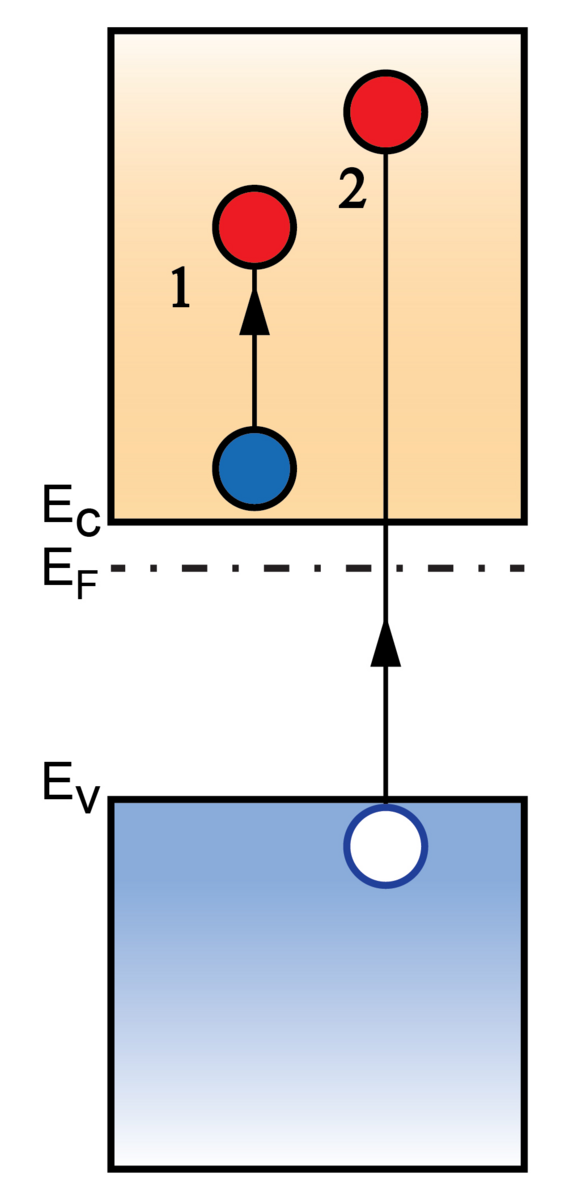
Hot carriers (HC) are free carriers with excess energy higher than the crystal lattice temperature. In a semiconductor, light can heat the carriers in two cases. First, if the photon energy hν is lower than the bandgap E\(_{g}\), the absorbed light contributes to heating through intraband transitions (Fig. 1, 1). Another possibility for creating HC is the interband absorption of photons with photon energy hν > E\(_{g}\). The excess energy, hν − E\(_{g}\), is used to heat the generated electron or hole (Fig. 1, 2).
The calculations of the efficiency of a single p-n junction solar cell (SC) absolutely ignore intraband absorption, which is treated as an intrinsic “below E\(_{g\) loss”} [1,2]. The indirect harmful impact of HC on the operation of a cell is considered only as a “thermalisation loss”; that is their excess energy is dissipated into the crystal lattice, thereby increasing lattice temperature and contributing to efficiency loss. On the other hand, despite their extremely short lifetime, HCs can provide benefits. An efficient hot carrier SC, a cell based entirely on the HC phenomenon, was proposed with efficiency reaching over 60% [3].
Thus, the role of hot carriers in photovoltaics remains ambiguous. Knowing the HC temperature is vital for modelling their influence and for guiding the design of next‑generation photovoltaic devices. Various techniques were developed to determine the temperature of the hot carriers. The most of these techniques are technically demanding or strongly dependent on the material and sample structure.
This study presents an experimental method for determining the HC temperature by analyzing the hot carrier-induced photocurrent across a p-n junction [4]. The objects of investigation included industrial poly-Si solar cells manufactured by SoliTek, and GaAs p-n diodes grown by liquid-phase epitaxy. The samples were illuminated with pulsed laser radiation at wavelengths of 1.342 μm for Si and 1.064 μm for GaAs. I-V characteristics were measured at 300 K and 80 K temperatures. The temperature-induced shift of the I-V curves is quantified by the temperature coefficient. A model based on the temperature coefficient was developed providing a direct measure of hot carrier temperature [5,6]. The obtained HC temperature values are reasonable and consistent with results reported in other studies. These results advance the understanding of HC phenomena in photovoltaic devices.
Overall, the developed temperature‑coefficient model offers an experimentally accessible route to determine hot carrier temperatures in solar cells. These findings enhance current insight into hot carrier generation and thermalisation, supporting future efforts to harness HC effects in advanced photovoltaic concepts.