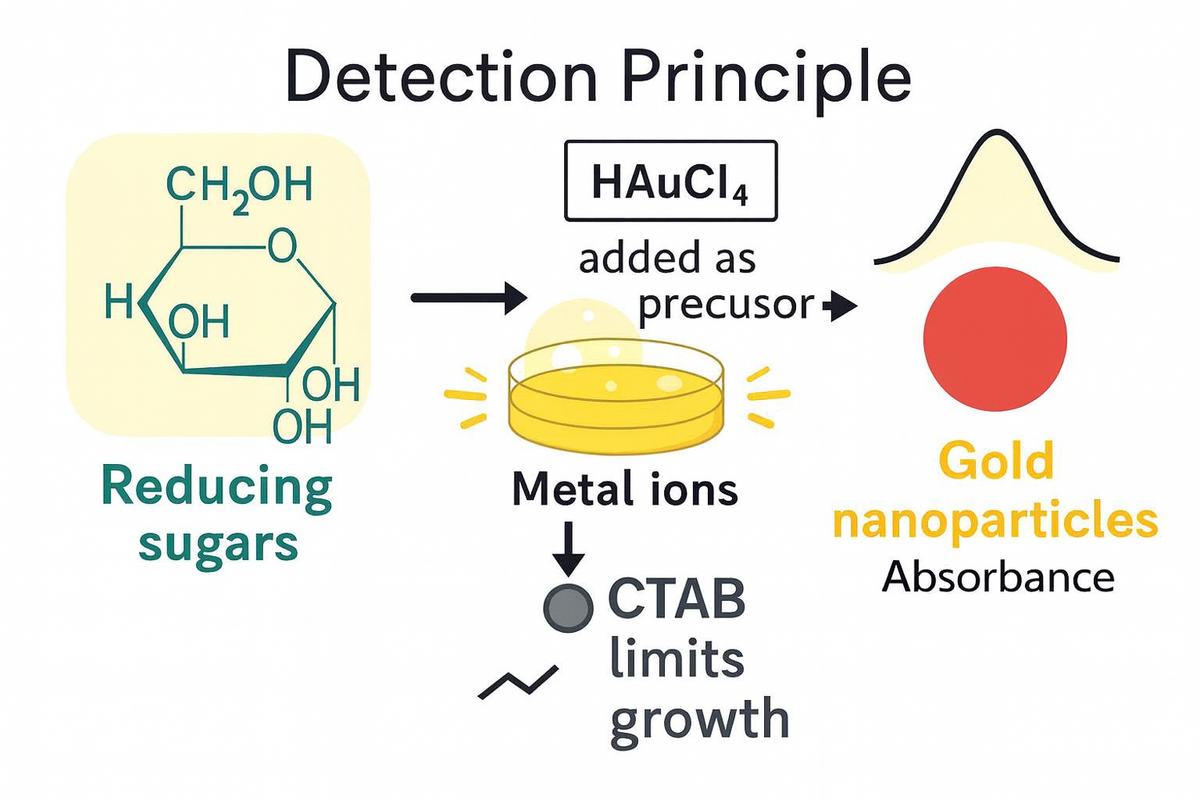
Because of their remarkable optical, electrical and magnetic characteristics nanomaterials can be applied across diferent fields of chemistry.Nanoparticles made from gold and silver are among the most widely used in organic fields such as organic catalysis, drug delivery, and biosensing due to their unique physicochemical properties and the possibility of precise size control [1].These tailorable features make it easy to adapt nanomaterials for intended applications.In particular, in the recent years gold nanoparticles have been extensively studied due to their vast properties like surface plasmon resonance, and their outstanding biocompatibility over others nanoparticle[2].Upon the reaction of gold ions(\(\mathrm{Au}^{3+}\))with reducing agents, such as reducing sugars the synthesis and growth of gold nanoparticules takes place.This well-known reaction is employed as an analytical signal to detect the presence of sugars, and as a green synthesis method.The UV-Vis technique is a perfect fit to monitor and evalute the kinetics of such a reaction by further exploiting optical features.However,reducing sugars play a critical role in the development of the signal, and aspects such as the functional group and acyclic sugar content define the reaction’s kinetics between gold atoms and the sugar itself and hence signal development [3].
This work aims to evalute the detection of reducing sugars leveraging the synthesis of AuNPs via reducing sugars.UV-vis spectroscopy was employed as technique to monitor the nanoparticle growth over time harnessing surface plasmon resonance of gold nanoparticles at 525 nm.In order to evaluate the overall reaction kinetics, parameters like sugar concentration, pH, temperature and surfactant amount were assessed to determine optimal reaction conditions. Experiments were conducted and evaluated with several reducing sugars specifically glucose, fructose, 2-deoxy-glucose, xylose, and mixtures of them.