FABRICATION OF GRAPHENE FIELD EFFECT TRANSISTOR ARRAY FOR BIOSENSING
Ujjawal Malani1, Aleksandra Širvinsytė1, Vilius Vertelis1, Skirmatas Keršulis1, Nerija Žurauskienė1
1 Center for Physical Science and Technology, Department of Functional Materials and Electronics, Vilnius, Lithuania
Rapid, sensitive, and cost-effective biosensing technologies are essential for applications in medical diagnostics, environmental monitoring, and point-of-care testing. However, many existing biosensing platforms remain limited by high cost, complex instrumentation, and slow response times, restricting their widespread deployment. Current solutions include surface plasmon resonance (SPR) [1], quartz crystal microbalance (QCM) [2], microcantilever sensors [3], and giant magnetoresistance (GMR) devices [4].
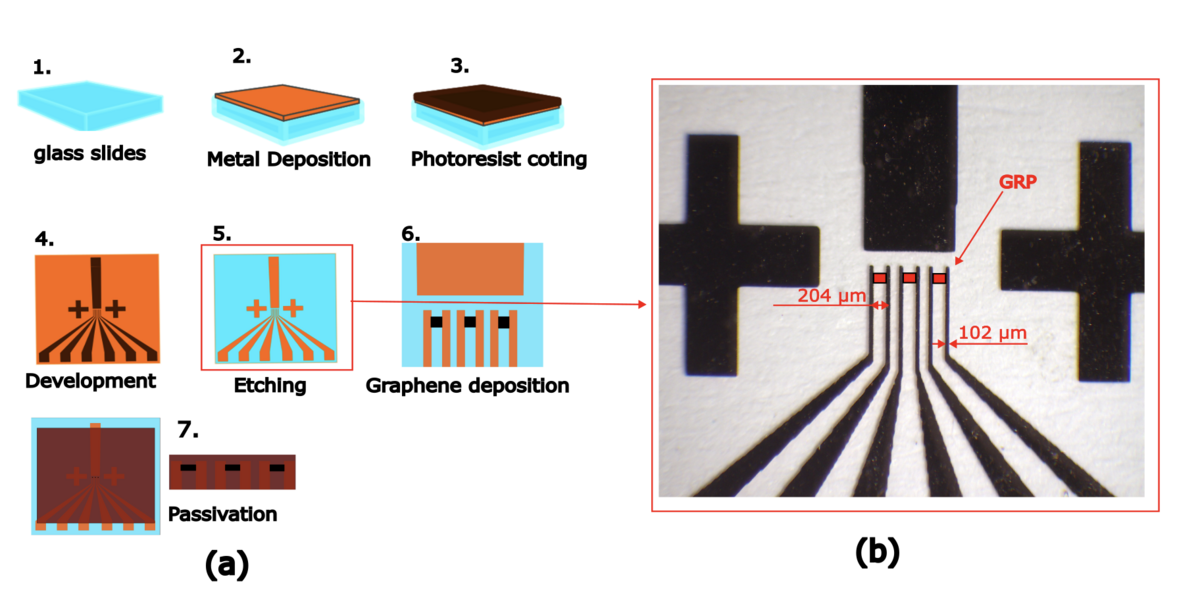
Graphene field effect transistors (FET) or G-FET is type of FET which is formed using channels made from graphene layer. Graphene is a 2-D material composed of carbon atoms in HCP lattice. G-FET in the context of biosensing offers high surface sensing, fast, label free electrical sensing and readout, it is biologically inert, has CMOS integration possibilities, and a broad range of detection [5]. However, production of graphene-based FETs currently faces several challenges due to extremely delicate and sensitive graphene it requires complex functionalization, meticulous care and expensive equipment. Throughout this study a GFET device was fabricated by depositing and patterning metal electrodes on glass substrates using photolithography, followed by the transfer of graphene onto the metal contacts. This study focuses on developing an efficient and cost-effective technological production route to produce sub millimeter functionalized G-FET biosensors arrays.
Fig. 1. (a) Technical route for the production of the sensor. (b) Micrograph of the base layer, where red marks labeled "GRP" indicate the locations at which the graphene will be placed.
[1] T. Špringer, M. Bocková, J. Slabý, F. Sohrabi, M. Čapková, and J. Homola, “Surface plasmon resonance biosensors and their medical applications,” Biosensors and Bioelectronics, vol. 278, p. 117308, Feb. 2025, doi: 10.1016/j.bios.2025.117308.
[2] H. J. Lim, T. Saha, B. T. Tey, W. S. Tan, and C. W. Ooi, “Quartz crystal microbalance-based biosensors as rapid diagnostic devices for infectious diseases,” Biosensors and Bioelectronics, vol. 168, p. 112513, Aug. 2020, doi: 10.1016/j.bios.2020.112513.
[3] J. Wang, B. Xu, Y. Zhu, and J. Zhao, “Microcantilever sensors for biochemical detection,” Journal of Semiconductors, vol. 44, no. 2, p. 023105, Feb. 2023, doi: 10.1088/1674-4926/44/2/023105.
[4] K. Wu, D. Tonini, S. Liang, R. Saha, V. K. Chugh, and J.-P. Wang, “Giant magnetoresistance biosensors in biomedical applications,” ACS Applied Materials & Interfaces, vol. 14, no. 8, pp. 9945–9969, Feb. 2022, doi: 10.1021/acsami.1c20141.
[5] K. Aran, B. Goldsmith, and M. Moarefian, “Applications of graphene field effect biosensors for biological sensing,” Advances in Biochemical Engineering, Biotechnology, vol. 187, pp. 37–70, Jan. 2024, doi: 10.1007/10_2024_252.