
Structured light carrying orbital angular momentum (OAM), known as an optical vortex, has gained growing interest in recent decades due to its potential applications in high-dimensional quantum communication and quantum information processing [1,2]. Recent full-vectorial studies of optical vortices interacting with electromagnetically induced transparency (EIT) media have revealed spatially dependent transparency and polarization transitions, enabling control of both OAM and spin angular momentum (SAM) encoded in the polarization states of light [3]. However, these effects have so far been restricted to four-level loop–tripod atomic systems that require a weak static magnetic field to establish the necessary quantum coherence. Here, the propagation of an optical vector vortex in a coherently prepared three-level-\(\Lambda\) configuration atomic medium is investigated, demonstrating an alternative EIT platform that supports quantum coherence without the need for a static magnetic field.
The weak vector probe beam is composed of paired vortex pulses carrying opposite OAM charges \(\pm l\), with opposite SAM associated with orthogonal circular polarizations of opposite handedness. The medium linear response to the vector vortex under the steady-state regime was analytically derived to determine the beam’s intensity and polarization evolution. We found that the topology of the vortex pairs is transferred to the atomic medium and produces \(2|l|\)-fold azimuthally structured transparency, transforming the beam’s intensity profile from a ring-shaped into a petal like pattern. An effective optical anisotropy is induced by the OAM-structured atomic coherence, enabling the evolution of polarization texture during the propagation. This evolution is controlled by tuning the initial ground-state populations, allowing the transition between left-circular, linear, and right-circulation polarizations [4].
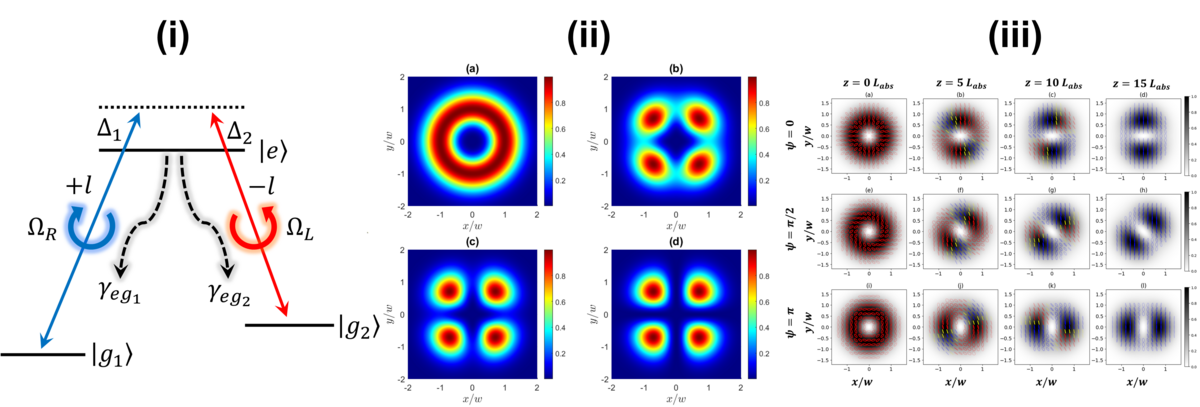
The results obtained suggest that the coherently prepared \(\Lambda\) configuration atomic medium can be considered as a potential EIT medium for OAM- and SAM-based application in a static magnetic field independent system.