High-frequency electrodeless discharge lamps (HFEDLs) are light sources that produce stable, intense, narrow emission lines, and have applications in atomic absorption spectroscopy, detection of contaminants with high precision, disinfection. Radiation emission happens from lowtemperature inductively-coupled plasma inside a small quartz glass bulb, which is excited using an external high-frequency coil.
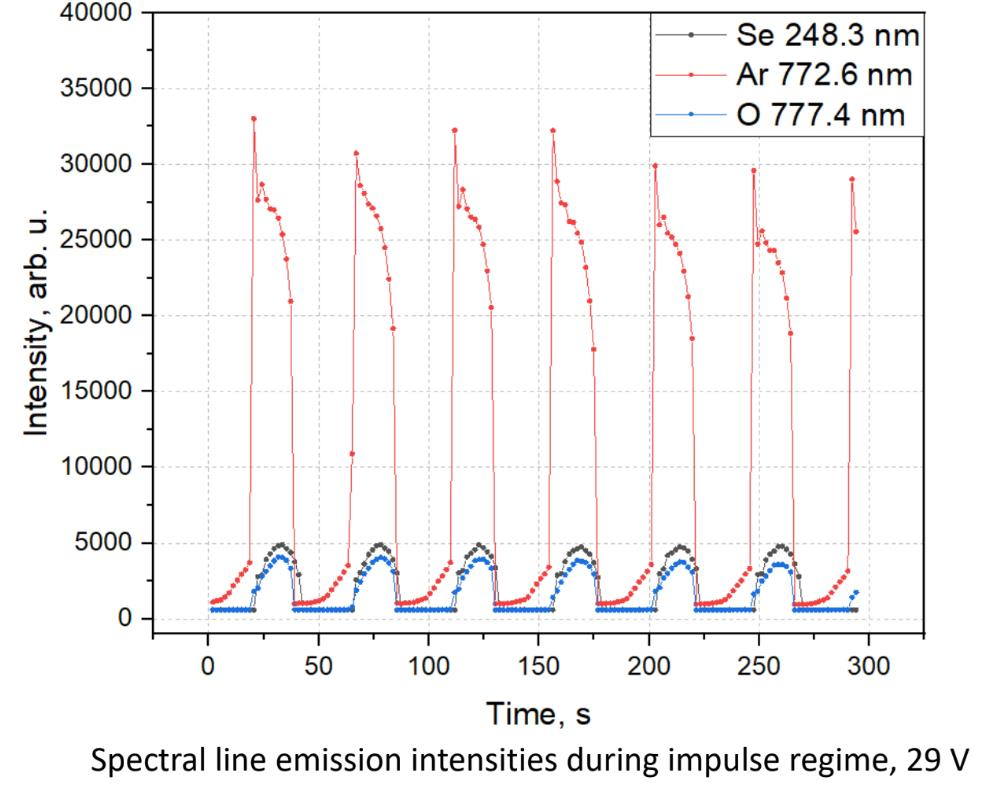
However, there have been observed phenomena where HFEDLs enter pulsed emission mode, where emission periodically changes (Figure 1). This effect is uncharacteristic and unintended for HFEDLs, and is yet to be fully understood.
In this work, we study pulsed emission of HFEDLs dependence on various parameters, including atomic oxygen. Oxygen was found during spectral measurements of HFEDLs in pulsed emission mode, where atomic oxygen spectral lines at 777 nm appeared. Oxygen is not introduced during lamp production, so the presence of these spectral lines indicate that oxygen from HFEDLs’ SiO2 walls participates in plasma excitation. As oxygen is highly electronegative, it may be the reason for plasma quenching in HFEDLs. For time-resolved spectral measurements, high-resolution (Δλ = 0.008 nm) spectrometer Jobin Yvon SPEX 1000M was used.
Spectral data analysis confirms, that oxygen emission intensity coincides with lamps’ working element (e.g. Se, Te) emission pulses. This work aims to improve understanding of the stability mechanisms in low-temperature inductively-coupled plasmas.