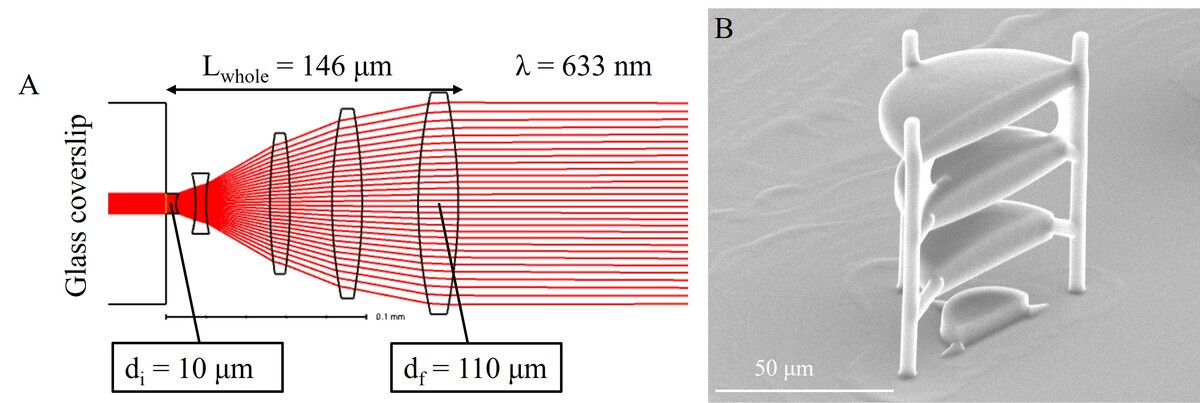
Over recent years, the field of modern optics exploiting free-form optics and flat optics such as metasurfaces at the microscale has attracted increasing research interest. This grow is driven by the aim to miniaturize optical elements and enhance overall compactness of optical systems while maintaining effective control of light through integrated designs. [1] Within this context, one of the key technologies enabling fabrication of miniaturized optics is multi-photon lithography (MPL) - a maskless 3D lithography technique which, in combination with highly transparent photoresist, allows the realization of free-form micro-optical elements. [2] At present, the practical extent to which micro-optical systems can be scaled down while still satisfying the assumptions of geometrical optics and the constraints imposed by MPL remains an open question. For instance, existing integrated optics designs report system lengths of several hundred micrometers to achieve sufficient beam diameter for effective light modulation. [3, 4] To explore the feasibility of further reducing the size of micro-optical system designs, this work investigates MPL fabricated micro beam expanders realized using an organic-inorganic hybrid photoresist - SZ2080\(^{TM}\), which enables the fabrication of accurate three-dimensional structures with high fidelity.
Initial designs of classical type Galilean beam expanders enable approximately threefold reduction in length compared to existing light structuring approaches. In addition, multi-lens beam expander configuration also mitigates vignetting effect caused by rapid beam expansion over short propagation distances. The results indicate that translating conventional optics concepts to micro-scale via MPL offers a promising approach toward compact micro-optical systems, enabling efficient light structuring within confined system geometries. The optical designs were developed using Zemax software, while the quality of the fabricated structures was assessed by optical profilometry and scanning electron microscopy. Beam expansion performance was evaluated using a home-built setup.