Sodium-ion batteries (SIBs) have emerged as a promising alternative to lithium-ion batteries due to the abundance and low cost of sodium precursors [1]. The development of optimal anode composition is crucial for enhancing the performance of SIBs, and polymer binders play a vital role in maintaining electrode integrity during cycling. Polyvinylidene fluoride (PVDF) is predominantly used as a binder due to its chemical stability, mechanical properties and ability to form a cohesive film [2]. Unfortunately, it is typically processed using toxic and volatile organic solvents, which raises environmental and health concerns [3]. Polyurethane (PUR) properties, such as strong adhesion, flexibility, and mechanical robustness [4], makes this polymer a promising alternative binder for sodium-ion batteries.
The aim of this work was to electrochemically investigate polyurethane in \(NaTi_{2}\)\((PO_{4})_{3}\) (NTP) based electrodes in order to determine the viability as a binder for aqueous sodium ion batteries. As PUR polyol component polydiethylene glycoladipate (PDEA of 2700 g/mol) were diluted with polyethylene glycol (PEG of 200 g/mol), to decrease PDEA initial viscosity. Polyol was then reacted with a trifunctional adduct of hexamethylene -1.6- diisocyanate (HDI3) in 1.5 mol excess. Electrochemical properties of the prepared anode electrodes were evaluated by cyclic voltammetry and galvanostatic cycling.
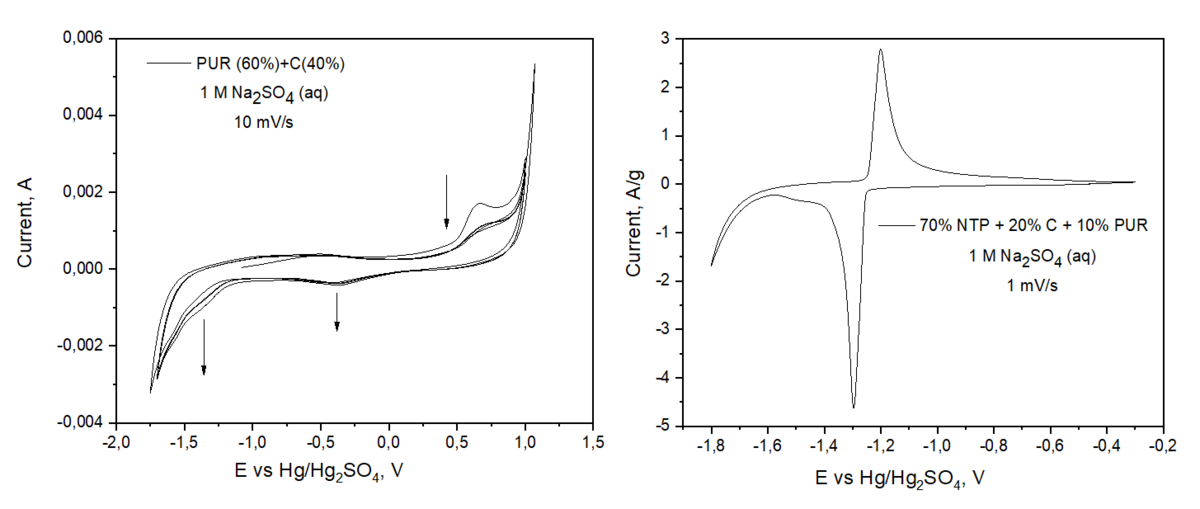
Cyclic voltammetry measurements demonstrated that the prepared electrodes are electrochemically active, as evidence by the observed current response (Fig. 1). Galvanostatic charge/discharge cycling (GCD) was performed using beaker-type three electrode cell. The results showed quite high initial capacity.