
The rising need for battery‑free IoT and wireless sensor networks calls for antennas that are compact, efficient, and thermally stable, yet traditional metal‑based designs tend to detune and suffer higher losses under temperature variations [1]. We present a horizontally oriented low‑profile dielectric resonator antenna (HODRA) made from high‑Q, temperature‑stable (Mg,Ni)TiO₃–Ca₀.₈Sm₀.₁₃TiO₃ ceramic (ε ≈ 17), whose performance and suitability for low‑power autonomous sensing are confirmed through a radio frequency energy harvesting experiment.
The horizontally oriented dielectric resonator antenna model is shown in Fig. 1. The cylinder is placed on a one-sided metalized surface of laminate FR-4. Antenna has two circular metal contacts that are equal in size. The pin connects the hot contact of the antenna with the central conductor of the 50 Ω coaxial cable, whereas the other contact of the antenna is connected to the grounded pin. 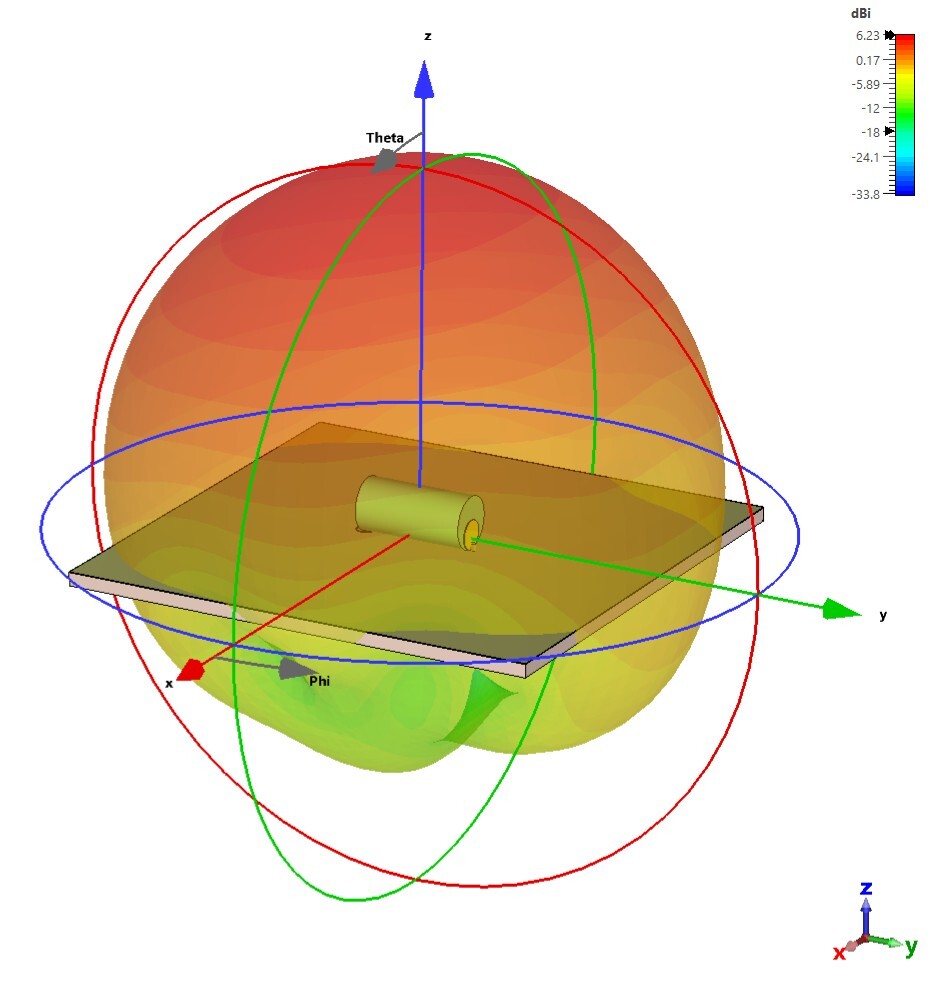
The antenna’s excellent performance was further evaluated in an energy harvesting system. A simple voltage doubler circuit was designed using two SMS7630 Schottky diodes. The rectifier impedance was matched to the 50 Ω antenna input using a quarter-wavelength impedance matching network. A horn antenna was transmitting 200 mW at 1 m distance, the rectenna was loaded with a 3 kΩ resistor. With a measured received power of –10 dBm at the antenna input, the rectenna delivered 170 mV across a 3 kΩ load, corresponding to 9.6 µW DC and an RF‑to‑DC efficiency of around 9.6%. Harvested power is significant because it is sufficient to operate a low-power management circuit capable of accumulating energy over time [2].
The presented horizontally oriented, low‑profile dielectric resonator antenna demonstrates excellent suitability for RF energy‑harvesting systems, combining high gain, low electromagnetic losses, and exceptional material stability to reliably power autonomous wireless sensor nodes and IoT devices. Its performance shows that ceramic‑based DRAs are a strong alternative to metal antennas at higher frequencies and paves the way for array‑based designs and deeper integration with advanced power‑management ICs to enable maintenance‑free operation.