Efficiency of light emission in GaN-based photonic devices is governed by the competition between radiative and nonradiative recombination. Both processes are strongly dependent on carrier density, including contributions from photoexcited carriers and background doping. Although GaN technology is well-established, unintentional doping remains present in GaN epilayers [1,2], complicating the interpretation of recombination dynamics. In this work, we investigate how variations in doping concentration affect the excitation-dependent photoluminescence (PL) behavior of GaN epilayers.
Twelve GaN epilayers with doping concentrations ranging from 2 \(\times\) 10\(^{15}\) cm\(^{-3}\) to 6 \(\times\) 10\(^{19}\) cm\(^{-3}\) were studied using PL spectroscopy. PL spectra were recorded at room temperature under excitation by a nanosecond laser (emission wavelength 266 nm) over a wide excitation power density range from 0.35 kW/cm\(^2\) to 25 MW/cm\(^2\). The emitted luminescence was detected using an ICCD camera, and the main emission band and its evolution was analyzed.
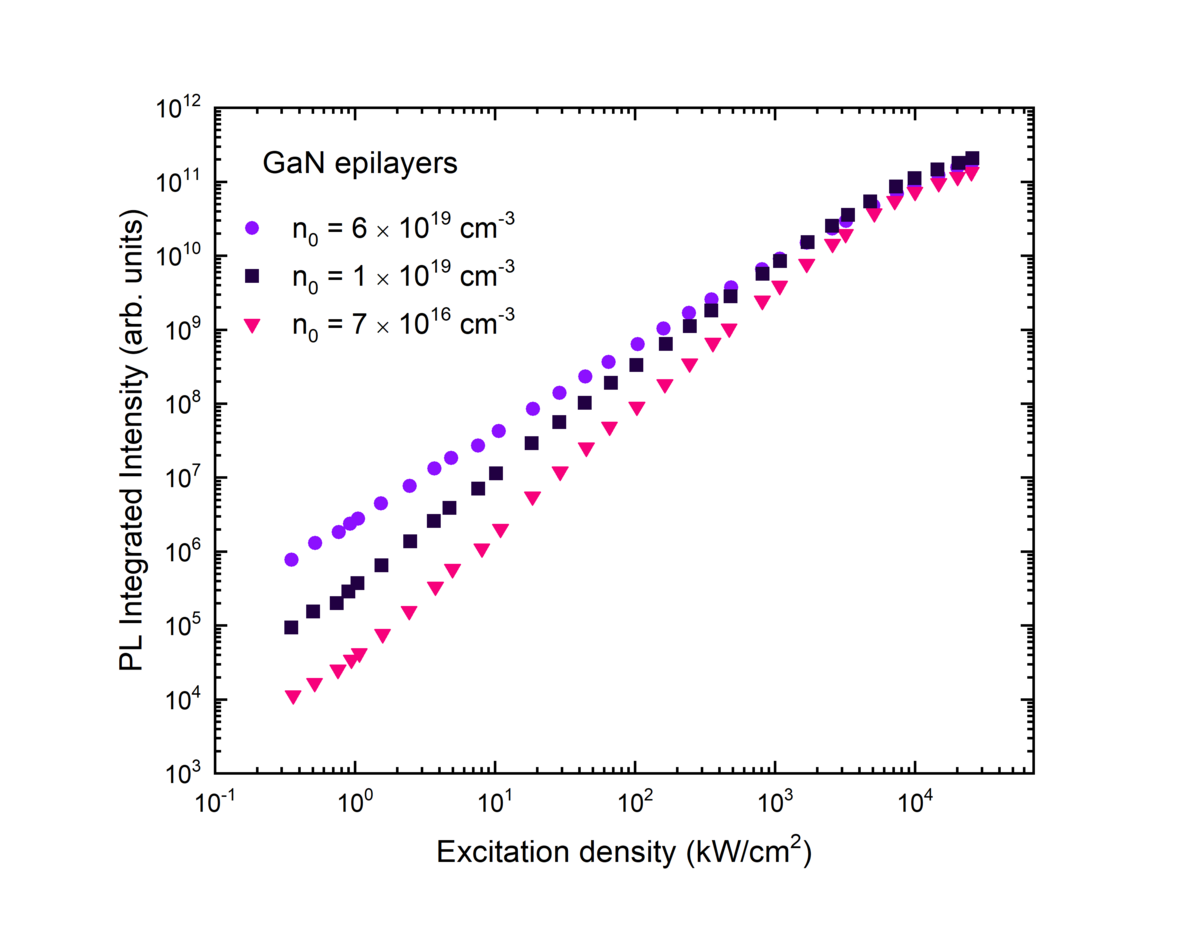
The PL measurements revealed clear excitation-dependent behavior, characterized by the spectral broadening, the redshift of the emission peak, and the decreasing spectral slope with increasing excitation. At the highest excitations, a narrow-stimulated emission band emerged. To quantify the overall emission response and to reveal doping-related differences, the PL spectra were integrated over the entire spectral range. As shown in Fig. 1 the integrated PL intensity exhibits a strong dependence on doping concentration, with lightly doped GaN layers displaying a steeper increase in emission intensity compared to heavily doped layers.
These results demonstrate that excitation-dependent PL behavior in GaN epilayers is strongly influenced by the background doping, especially at low excitations. Consequently, modeling of PL intensity or efficiency dependences has to explicitly account for the background carriers.