
Full-field vibrometry techniques such as frequency shifted or phase modulated interferometry already offer considerably short acquisition times compared to scanning methods such as Laser-Doppler-Vibrometry when high spatial resolution is required. However, when measurements with picometer-sensitivity are to be performed, this can only be achieved by recording a large number of frames with a subsequent narrowband (lock-in) filtering during digital postprocessing. Due to the limited frame rate of regular CMOS camera sensors, the acquisition time then can be several seconds to minutes and the computationally intensive evaluation of the large image stack further adds to the measurement time.
Both problems are addressed by the use of a smart-pixel camera that implements an electric lock-in circuit in every pixel before AD-conversion [1]. It supports the demodulation of frequencies even beyond 100 kHz which means that the same number of oscillation periods can be acquired significantly faster compared to a regular camera. As illustrated in figure 1, the filtering is applied in the analogue domain and only a single frame is produced in the end, which can be instantly further processed compared to a whole stack of images that must first be processed and filtered digitally. This should enable such interferometric setups to perform even highly sensitive measurements in real-time (i.e. several measurements per second). 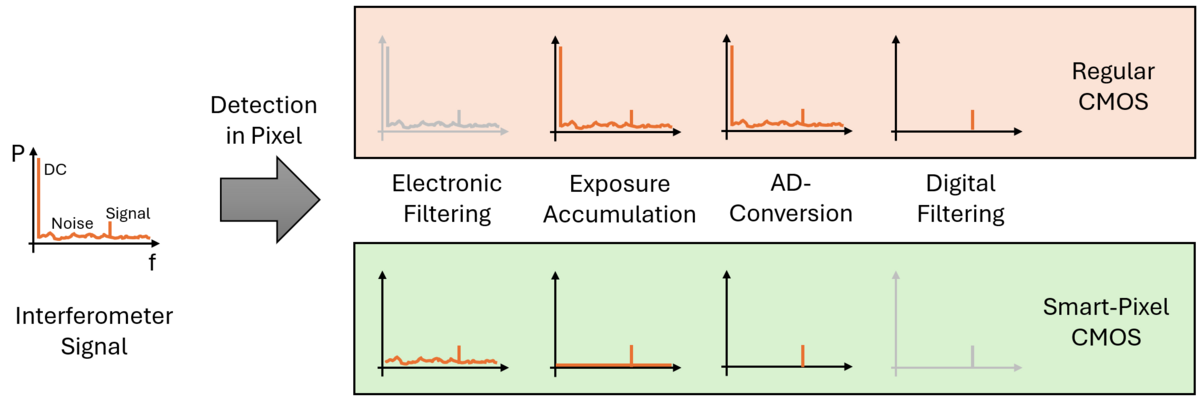
In this submission, we will present first measurements using the smart-pixel camera inside an established interferometric full-field vibrometry setup. We compare the results to the ones obtained with a conventional camera detector and discuss advantages and limitations.