
Conductive and stimuli-responsive hydrogels offer promising opportunities for drug delivery systems by enabling both passive diffusion and stimulus-triggered release. In this study, alginate-based composite hydrogels incorporating polyaniline (PANI), poly(3,4-ethylenedioxythiophene) (PEDOT), and their combinations are being developed to investigate passive and active drug release mechanisms. Sodium alginate hydrogels are ionically crosslinked with calcium ions, and methylene blue is used as a model compound. The hydrogels are being characterized in terms of swelling behavior and electrical conductivity. Passive release studies under physiological conditions have demonstrated sustained, diffusion-controlled release behavior, while active release experiments are expected to evaluate the influence of electrical stimulation on release kinetics compared to passive diffusion. Hydrogels containing PEDOT and PANI-PEDOT are anticipated to exhibit enhanced conductivity and more pronounced electroresponsive release compared to PANI-only systems. Comparative analysis will be performed to elucidate the roles of polymer composition and stimulus type in governing release profiles. 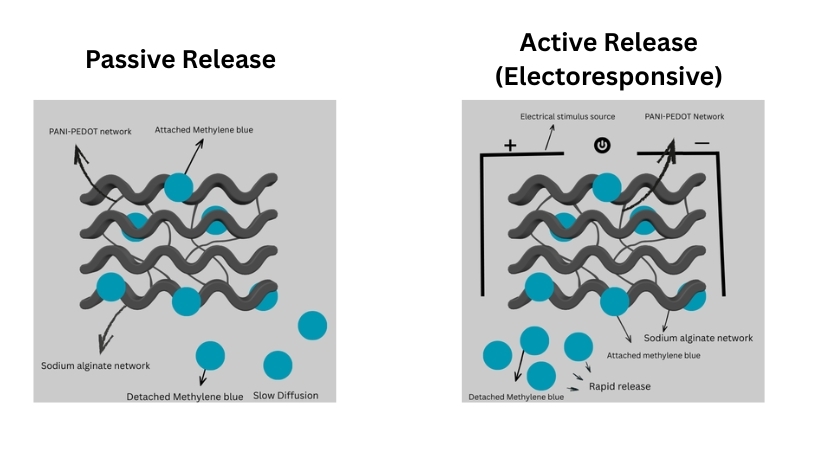
STIMULI-RESPONSIVE ALGINATE-BASED CONDUCTIVE HYDROGELSINCORPORATING PANI AND PEDOT FOR TUNABLE DRUG RELEASE
Shahbaz Khan1, 2, Šarūnas Žukauskas1, 3, Arūnas Ramanavičius1, 2, Felix Luecke1
1 Center for physical sciences and Technology (FTMC)
2 Vilnius University
3 State Research Institute Centre for Innovative Medicine
Fig. 1. Schematic Representation of Passive and active release