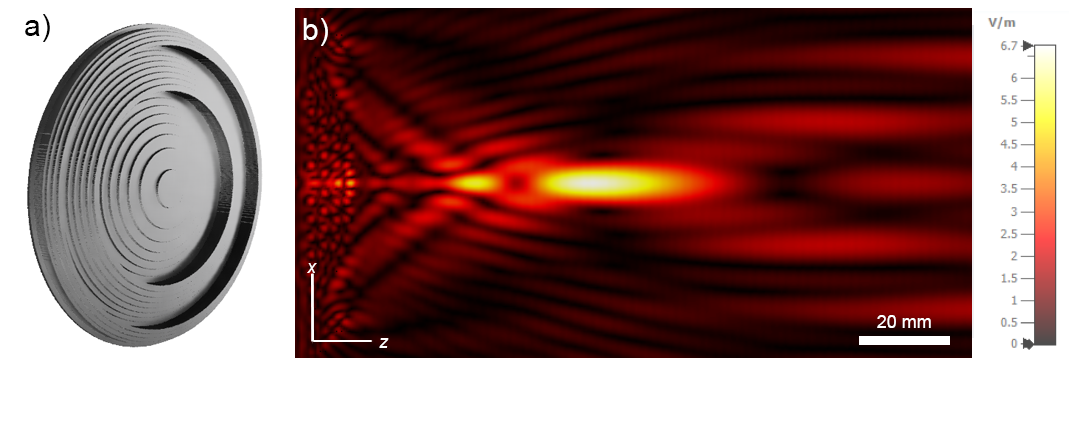
The sub-terahertz (sub-THz) frequency band (below 300 GHz) has attracted great interest for applications in next-generation wireless communications, offering ultra-broadband channels far beyond today’s microwave and millimeter-wave systems [1]. A major challenge, however, is the high free-space path loss at THz frequencies, which limits transmission distance and reliability. One way to overcome this is by using high gain focusing elements to direct and enhance THz signals. Conventional beam shaping approaches - like refractive lenses or parabolic mirrors - tend to be large, heavy and expensive, which limits their suitability for compact optical setups. In contrast, diffractive optical elements (DOEs) provide a compelling option, as they manipulate the wavefront through phase modulation to achieve highly efficient focusing in a thin, lightweight form factor.
In this work, we explore the use of 3D printable DOEs made of high impact polystyrene (HIPS) suitable for 93 GHz beam focusing. We designed a range of flat Fresnel lens type DOEs with various focal lengths (5-15 cm), apertures (5-15 cm diameters) and phase quantization levels (step-like profiles of 2, 4, 8, 16, 32 steps) and evaluated their ability to improve the signal directivity of a THz communication system. The key metrics of interest were the peak focal intensity and the focal beam width. For communications, a narrower, high-intensity beam is desirable to extend range and reduce interference. Such lenses could serve as compact antenna gain modules: for example, placed in front of a THz transmitter or receiver to significantly boost effective radiated power or receiver sensitivity.
Additionally, the antireflective (AR) structures can enhance transmission signal gain of such beam altering elements [2]. THz transmitters often have limited output power, so preserving as much of that power as possible is important. Using finite-difference time-domain (FDTD) electromagnetic simulations, DOEs combined with AR structures could be analyzed as it is important to find best matching case designed for 93 GHz signal enhancement. This could be used in the future for developing sub-THz antenna boosters, tailored to specific frequencies or beam requirements, at a low manufacturing cost. Therefore, it would find applications in indoor THz networks or fixed point-to-point links, where inexpensive plastic lenses could replace much heavier and costlier parabolic antennas.