Amyloid fibril formation is a central pathological feature of numerous neurodegenerative and systemic disorders, including Alzheimer’s disease, Parkinson’s disease, and type II diabetes. The accumulation of misfolded proteins into insoluble amyloid aggregates disrupts cellular homeostasis and causes cytotoxic effects, underscoring amyloidogenesis as a critical therapeutic target. Consequently, considerable research efforts have been directed toward the development of small-molecule inhibitors capable of modulating protein aggregation pathways or stabilizing non-toxic protein conformations [1].
Among various classes of bioactive compounds, heterocyclic systems containing imidazole or benzimidazole fragments have attracted significant attention due to their favorable electronic characteristics and ability to interact with biomolecular targets [2]. Compounds bearing the imidazo[2,1-b][1,3]thiazine scaffold have demonstrated a broad spectrum of biological activities, including anti-inflammatory, antifungal, anti-tuberculosis, and amyloid aggregation inhibitory effects [3]. These molecules are further distinguished by their chemical stability and selective binding properties, making them promising candidates for the development of novel modulators of amyloid fibril formation.
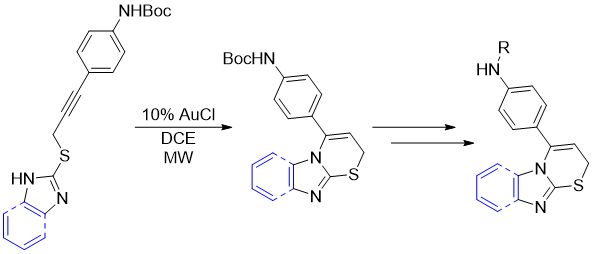
In this work, a series of compounds containing imidazo[2,1-b][1,3]thiazine or benzimidazo[2,1-b][1,3]thiazine fragments were synthesized and further modified. The synthetic strategy was based on an initial cyclization reaction to construct the corresponding heterocyclic core structures. Subsequent post-cyclization modifications focused on the functionalization of the amino group, enabling the introduction of various substituents through reactions with suitable electrophilic reagents. This approach allowed the generation of structurally diverse derivatives for further studies.