Late-stage functionalization has become a powerful strategy in modern drug development as it enables rapid diversification of complex, bioactive molecules without the need for de novo synthesis. Selective modification of advanced intermediates or lead compounds accelerates exploration of chemical space and study of structure–activity relationships, thus facilitating the fine-tuning of potency, selectivity, and pharmacokinetic properties. This approach reduces time, cost, and synthetic risk, making it especially valuable in lead optimization and the generation of analog libraries. As a result, many methods of late stage derivatization have recently been developed, especially such strategies as molecular editing [1] and C-H functionalization [2].
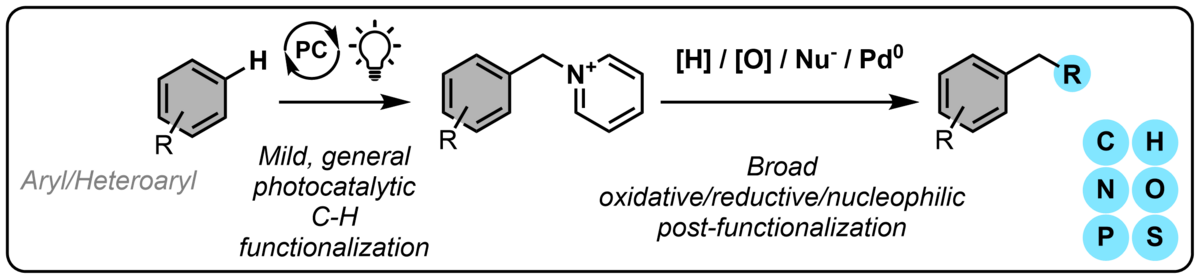
This work presents a novel photoredox catalysis-based method for mild and robust (hetero)arene C-H functionalization to provide the corresponding (hetero)benzyl pyridinium salts (Fig 1.). The method relies on a reagent that can be prepared from common, inexpensive laboratory chemicals, along with either organic or iridium-based visible light photocatalysts. The reaction, performed at room temperature, has successfully been performed on electron-rich, neutral, and some electron-poor (hetero)aryls, and has showed high functional group tolerance, which has allowed for it to be used on pharmaceutically active and drug-like substrates with good to excellent yields. A wide variety of mostly novel post-functionalization methods have been developed for the resulting pyridinium intermediates, including oxidation to aldehydes, multiple-level reductions, and nucleophilic functionalizations with both classical nucleophiles (e.g. amines, thiols and carboxylates) as well as palladium-catalyzed Suzuki/Hiyama/Sonogashira - type reactions.