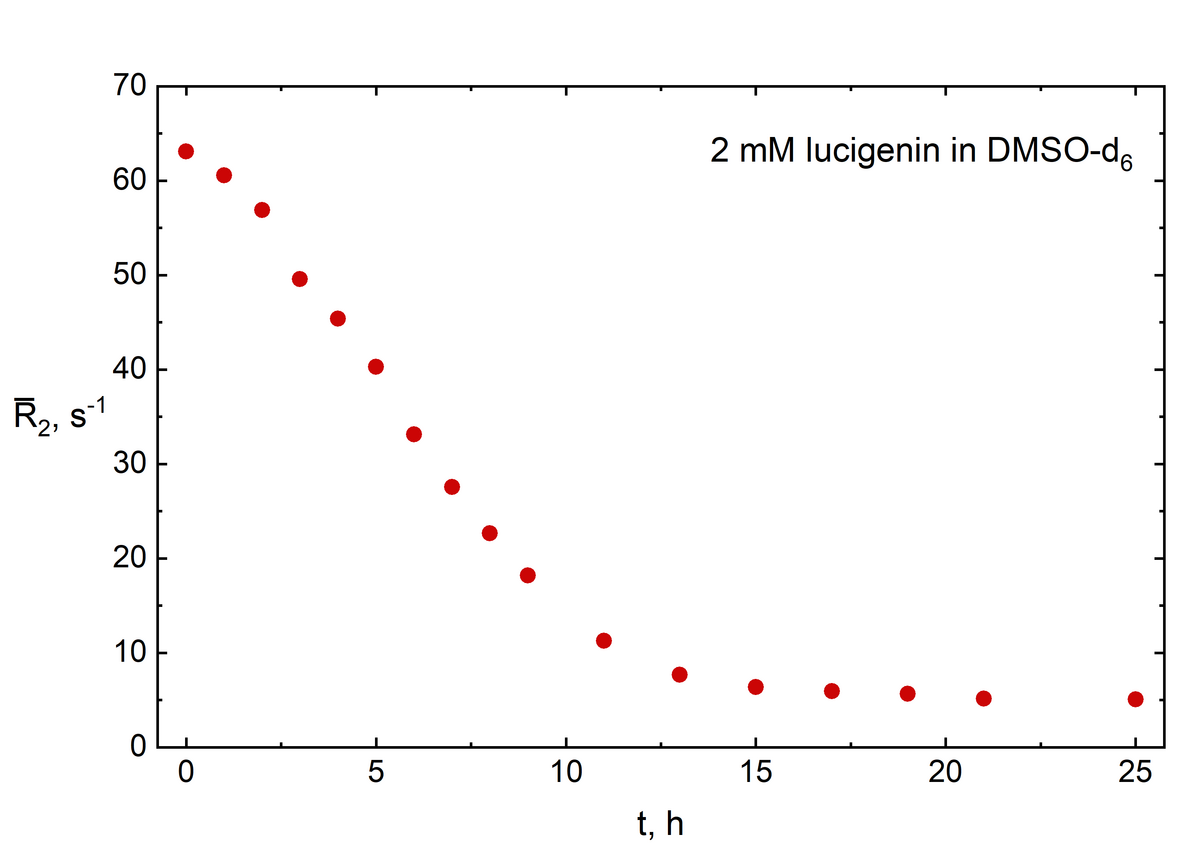
Photochemical and photophysical phenomena are involved in all life and related processes such as photosynthesis, the degradation of plastics, photodegradation of drugs. Scientists are continually developing new concepts, molecules, and functional materials based on photochemical and photophysical processes. To characterize often UV-VIS spectroscopy, molecular dynamics (MD) calculations are used as well as Electron Paramagnetic Resonance (EPR) in some cases. Although photo-chemistry primarily involves excitation of electrons, the monitoring of slow dynamics can be performed by Nuclear Magnetic Resonance (NMR) which complements with insight in molecular structure and changes in molecular mobility [1]. In this work, NMR relaxation is studied in lucigenin, a known aromatic compound in a number of chemiluminescent and fluorescent assays. Some studies suggest that lucigenin and its luminescence is related to reduction of Luc2+ to radical form Luc*+ [2]. Therefore, one could expect that radical form of lucigenin should cause paramagnetic relaxation in NMR which can be observed over time.
Both longitudinal and transverse relaxation times were analysed using inversion recovery and Carr-Purcell-Meiboom-Gill (CPMG) pulse sequences. The measurements were performed after intense photo excitation using white light. Samples consisted of lucigenin and pentetic acid in variable concentrations which seemed to influence the rate at which system fully recovers back to an unexcited state. Moreover, we have noticed that the lack of oxygen considerably changes this rate. These findings favour the hypothesis that oxygen present in the solution may quench radical via chemical reaction [2] and demonstrate that NMR spectroscopy potentially can be used for analysis of similar systems.