The rapid growth of information technology has heightened the need for advanced anti-counterfeiting measures, shifting focus toward optical encryption that utilizes dimensions beyond the visible spectrum. While the mid-infrared range offers a natural advantage for data concealment, current methods for controlling thermal radiation often rely on complex multi-layer structures or expensive materials that are difficult to scale [1]. This study investigates the feasibility of controlling the thermal emissivity (\(\epsilon\)) of fused silica through femtosecond laser surface engraving. The research seeks to establish a precise relationship between laser-induced surface morphology and thermal emission properties to create a platform for hidden, thermally activated data encoding.
Surface engraving was performed on fused silica using a femtosecond laser (\(\lambda = 1030\) nm, \(\tau = 211\) fs). By systematically varying the energy density (\(F\)) and pulse overlap (\(\Omega\)), different surface roughness (\(S_a\)) values were achieved. Emissivity measurements were carried out using an infrared camera in the MIR atmospheric window (7.5–14.0 \(\mu\)m).
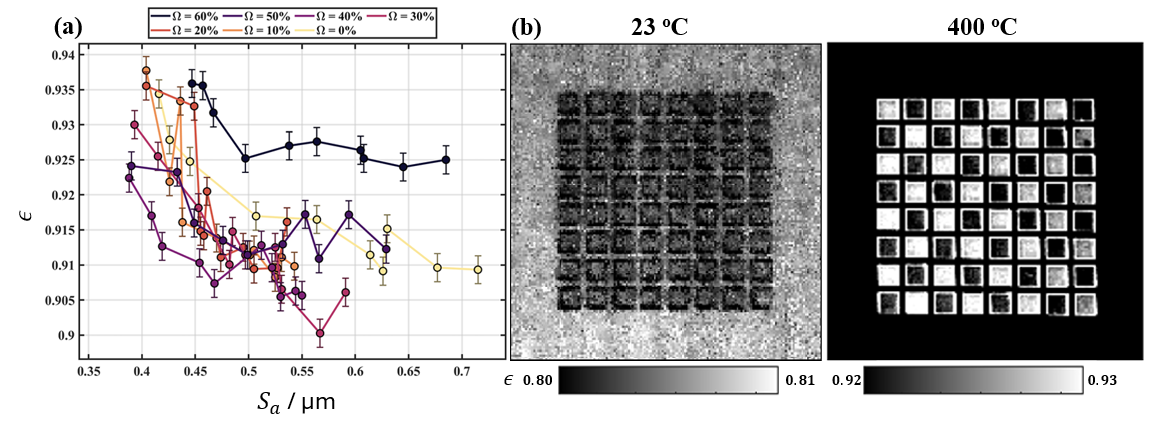
Experimental results show that surface emissivity can be precisely tuned even with minimal topographical changes (\(\Delta S_a < 10\) nm). Notably, as seen in Fig. 1 (a) increasing the surface roughness of fused silica leads to a decrease in thermal emissivity, suggesting that the emission is governed by structural changes in the ablated layer and modified scattering angles.
The practical application of the findings was demonstrated by encoding complex patterns, including a chessboard seen in Fig. 1 (b) onto the fused silica surface using two distinct fluences (4.4 J/cm\(^2\) and 12.5 J/cm\(^2\)) and \(\Omega = 30\%\). While these encoded patterns remain invisible to the naked eye, heating the substrate to 400 \(^\circ\)C provides the necessary thermal activation to reveal high-contrast, decodable information via a thermographic system.
This research demonstrates that laser engraving fused silica provides a robust and scalable method for programming thermal radiation. The findings offer a promising solution for high-security applications, such as heat-activated encryption and anti-counterfeiting labels that remain hidden under ambient conditions.