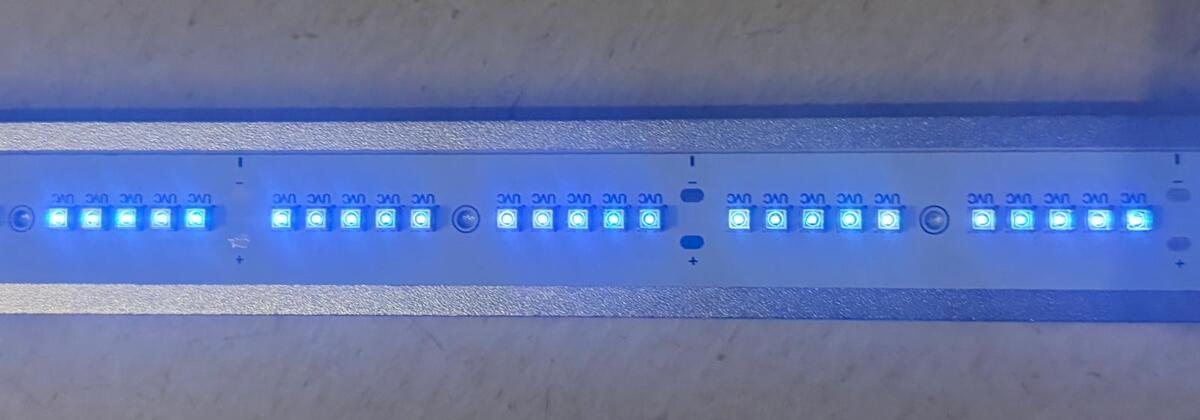
The most recent pandemic highlighted the urgent need to develop additional methods for the disinfection and inactivation of human pathogens, in order to improve preparedness for future crisis scenarios. Although the germicidal effectiveness of UV-C radiation is well established, experimental studies and practical applications still predominantly rely on mercury low-pressure (or medium-pressure) lamps, whose principal emission line is at 254 nm [1].
The aim of this work is to investigate the use of UV LEDs for disinfection, with the goal of replacing the widely used mercury (Hg) lamps in the future, thereby limiting the spread of toxic mercury in the environment.
In this work, we studied irradiation of a UV-C (peak intensity at 272 nm) diode strip (Figure 1). The strip is 50 cm long, consisting of 70 individual UV-C diodes, which is being tested for application in a disinfection apparatus. The peak radiation power of the LED strip is 2.1 to 2.8 W. For implementation purposes, spatial irradiation distribution of the whole strip, groups of diodes, and singular diodes was measured using the Ocean Optics HR-4000 spectrometer.
As the wavelength of emitted light from diodes is not a singular emission line, each radiation measurement was integrated across the wavelengths of 260 nm to 290 nm to obtain absolute irradiation in μW/cm\(^2\). This work helps with developing and designing a prototype of a UV disinfection apparatus for medical and civil purposes.