A high repetition rate of the laser source (>50 MHz) is a desirable characteristic in most applications, as it enables higher scanning speeds, the acquisition of a larger amount of data, and consequently improves statistical reliability [1] and the signal-to-noise ratio [2]. When working with biological samples, a high repetition rate can also reduce the probability of photodamage [3]. The development of high average power laser sources is therefore crucial for extending the capabilities of high repetition rate systems and enabling demanding applications that are otherwise power-limited. To this end, a unique hybrid pre-chirp managed amplification (PCMA) and fiber chirped pulse amplification (FCPA) system generating 114 fs pulses with a repetition rate of 76 MHz and an output power of 72 W has been developed at the Vilnius University Laser Research Centre [4]. In addition to high repetition rate and high average power, most commercial and scientific applications demand a broad wavelength tunability, low noise levels, and long-term operational stability. Since the wavelength tuning range of a laser is limited by the gain bandwidth of the laser medium, nonlinear optical frequency conversion processes, such as optical parametric generation and amplification (OPG/OPA), are employed to achieve broad wavelength tunability. Recently, an optical parametric amplifier operating at a high repetition rate and exhibiting record-high average power, seeded with a supercontinuum generated in a bulk crystal, was demonstrated [5]. Here, we demonstrate that the OPA output power can be further scaled by employing a fiber-based supercontinuum seed.
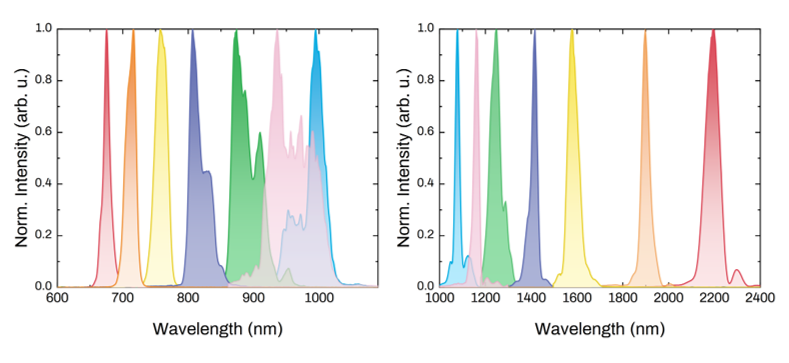
Therefore, a two-stage optical parametric amplifier (OPA) based on lithium triborate (LBO) crystal has been developed with unique pump characteristics: high repetition rate (76 MHz) and high average power femtosecond pulses. This OPA seeded with a supercontinuum generated in all normal dispersion photonic crystal fiber (ANDi PCF) has demonstrated a wide wavelength tuning range in the VIS and NIR spectral regions, covering wavelengths from 670 nm to 1030 nm for the signal wave and from 1030 nm to 2200 nm for the idler wave (Fig. 1.). High average output powers of signal and idler exceeding 14 W have been demonstrated after two-stage amplification, with a maximum conversion efficiency of around 40% at 900 nm central wavelength. The amplified pulses are compressible in time to near transform-limited durations. This OPA, featuring a unique combination of exceptional parameters, constitutes a first step toward the realization of a high repetition rate and high average power laser source operating in the mid-infrared spectral region.