
High-performance TADF emitters are currently in great demand for applications in full-color displays and solid-state lighting. These materials can reach up to 100% internal quantum efficiency without relying on noble metals. However, overall eficiency is still limited by slow and inefficient reverse intersystem crossing (RISC) processes [1]. Herein, we introduce a series of 3-(dephenylamino)carbazole-based compounds with a potential of multi-channel RISC. The structures of materials are shown in Fig. 1. 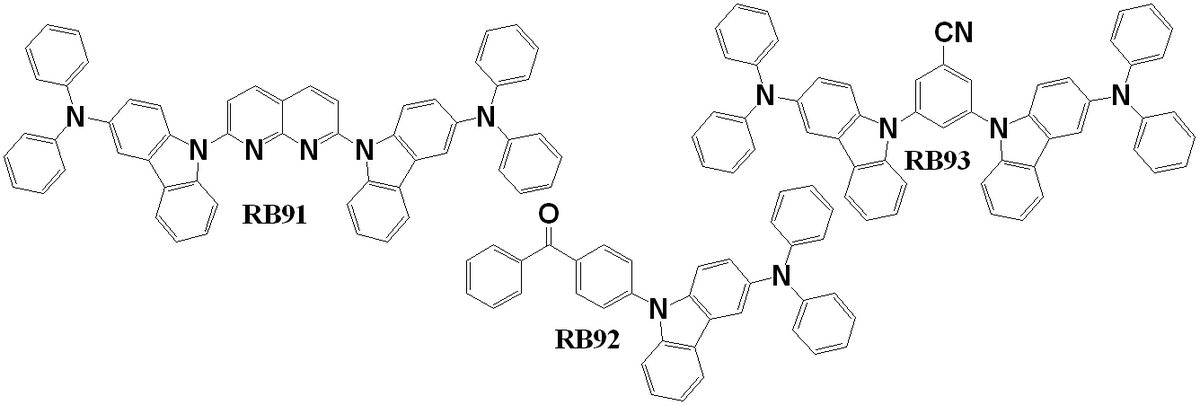
DESIGN OF NOVEL 3-(DIPHENYLAMINO)CARBAZOLE COMPOUNDS FOR MULTI-CHANNEL GREEN TADF OLEDs
Raminta Beresneviciute1, Inesa Sasnauskaite1, Zeyad Taher Abdou1, Dovydas Blazevicius1, Saulius Grigalevicius1, Wanting Ju2, Xiangqin Gan2, Junqiao Ding2, Kaspars Traskovskis3
1 Kaunas University of Technology, Department of Polymer Chemistry and Technology, Kaunas, Lithuania
2 Yuann University, School of Chemical Science and Technology, Kunming, P. R. China
3 Riga Technical University, Faculty of Natural Sciences and Technology, Riga, Latvia
Acknowledgments: We are obliged to the Research Council of Lithuania for the support (Grant. No. S-LLT-25-2). KT acknowledges the financial support of the Latvian Council of Science (project LV-LT-TW/2025/4).
[1] K. Kumar, “High-Efficiency Functional Materials: Challenges and developments in solution and dry processed green OLEDs,” Reaction Chemistry & Engineering, vol. 9, no. 3, pp. 496–527, Jan. 2024, doi: 10.1039/d3re00410d.