Surface plasmon polaritons (SPPs) are electromagnetic waves that propagate along a metal-dielectric interface. Their excitation relies on the coupling between coherent oscillations of free electrons and photons, which can be drastically enhanced with the grating coupler approach [1]. Scattered light in the periodic arrays of metallic nanosotructures interfere constructively with damping of localized plasmon resonance (LPR) of individual structures, resulting in ultra-narrow plasmonic resonance known as a surface lattice resonance (SLR) [2]. SLR has a wide range of applications in sensing [3], but can also be used to enhance the spontaneous emission rates of organic fluorescent molecules deposited on top of structured metallic surface. In this work we present various energy exchange dynamics, differing in decay rates, by implementing a near-field collection via supercritical angle fluorescence (SAF) microscopy.
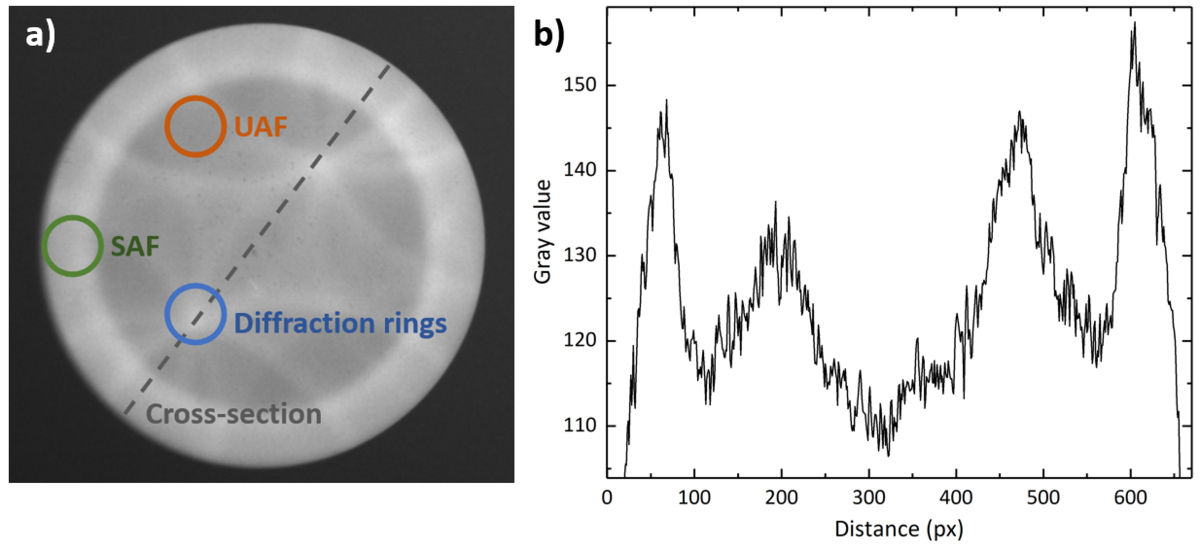
We investigate a metallic structure of gold bumps (period around 500 nm) on 50 nm thick gold, with drop-caster and evaporated fluorescent dye of rhodamine R6G, dissolved in water on top of the structure. The fluorescence was excited with a 515 nm femtosecond laser through oil immersion objective, collected in an epi-configuration and filtered at 600 nm. Additionally, a 4F optical system with an adjustable aperture was used for spatial filtering of the back focal plane (BFP) to select particular fluorescence signals (Fig. 1). Near-field and far-field emissions were examined and attributed to SAF and undercritical angle fluorescence (UAF) respectively. UAF mostly contains the uncoupled dye molecules in the bulk dye, thus exhibiting a longer fluorescence lifetime. On the contrary, the SAF decay is fastest and limited by the instrumental response function (IRF) of the detector. This is due to the combination of radiative energy enhancement and non-radiative fluorescence quenching in our sample [2]. The latter effect occurs when an excited-state fluorophore is in close proximity to a metal surface and an instant energy transfer to surface electrons is induced. As radiative and non-radiative decay rates increase, the total lifetime of SAF decreases. In addition, the first-order diffraction rings, formed from multidirectional leakage radiation by SLR, were also observed and had a mix of lifetimes due to UAF influence and filtering limitations.
The lifetime decay measurements were consistent with theoretical predictions, despite being IRF limited. Research on SLR-enhanced coherent emission can lead to development and improvement of quantum nanophotonic devices as well as advanced microscopy and optical biosensing [4].