Photosynthesis is a fundamental physiological process underlying plant growth and biomass production and is therefore central to plant performance under both optimal and adverse environmental conditions. Understanding the mechanisms that regulate photosynthesis is essential for improving predictions of plant performance under changing environment.
Beyond photochemical and biochemical regulation, plants generate electrical signals in response to diverse environmental stimuli, including both biotic and abiotic stressors. These signals – such as action potentials – arise from transient changes in the activity of ion transport systems (channels and pumps) and enable rapid information transfer within the plant, often leading to systemic responses such as increased stress hormone synthesis. The functional role of electrical signals in the regulation of photosynthesis remains underexplored. Experimental studies investigating the effects of action potentials on photosynthetic activity have yielded contradictory results: while most report a transient inhibition of photosynthesis following electrical excitation, others suggest an opposite effect.
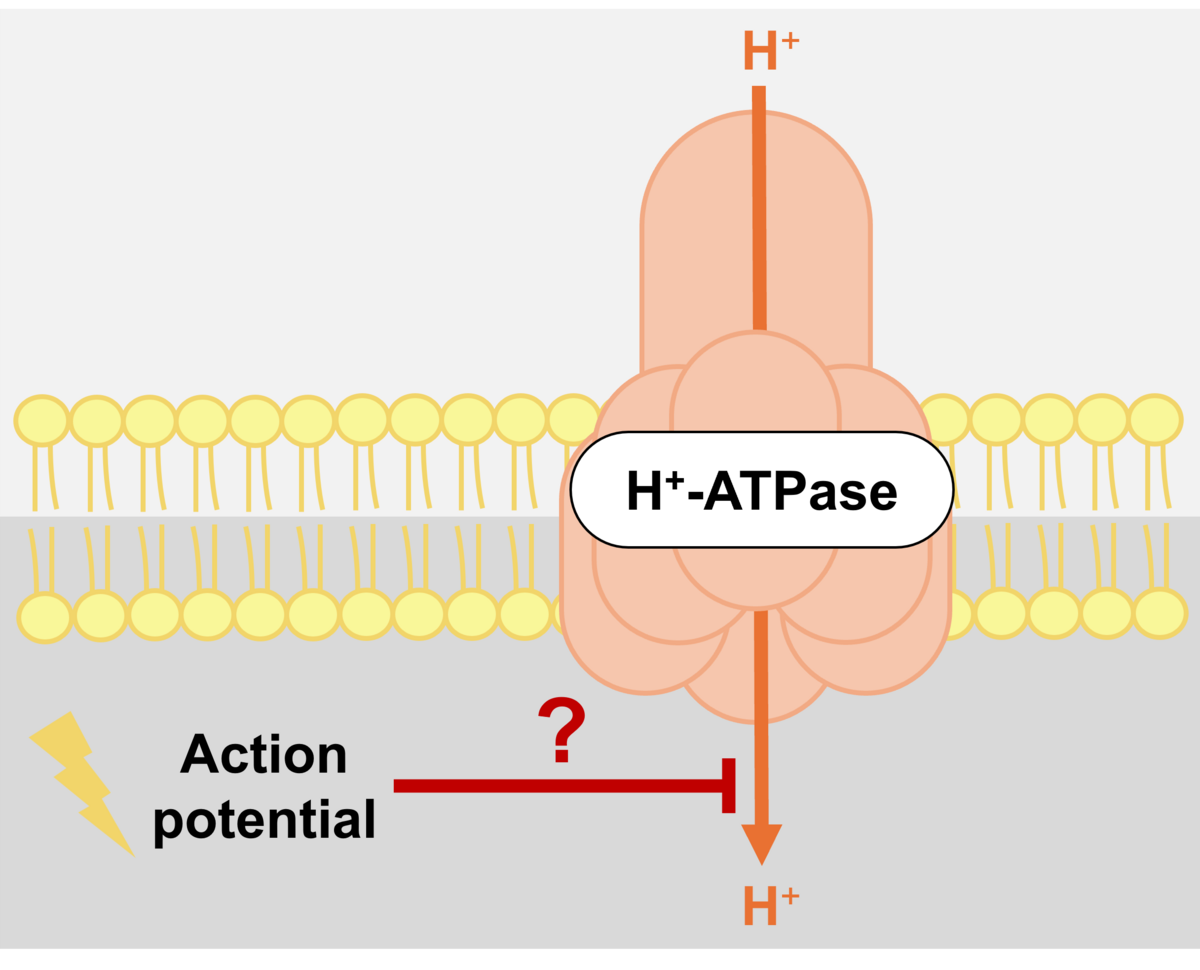
This study used the freshwater characean macroalgae Nitellopsis obtusa, whose unique cellular morphology enables simultaneous application of electrical stimulation and pulse-amplitude-modulation (PAM) chlorophyll fluorometry in a single cell. This experimental approach enabled direct correlation between electrical signaling and photosynthetic responses. The results show that the generation of a single action potential causes a transient inhibition in the rise of non-photochemical quenching (NPQ), a key photoprotective mechanism responsible for dissipating excess light energy. Because NPQ depends on the transthylakoid pH gradient, it can be hypothesized that action potential generation reduced this gradient, for example by transiently suppressing the activity of plasma membrane H\(^{+}\)-ATPases (Fig. 1) and / or initiating Ca\(^{2+}\) signaling that modulates H\(^{+}\) transport processes within the thylakoid membrane [1].