
Boron-doped p-type LGAD detectors are expected to play an important role in future CERN experiments owing to their excellent timing performance [1]. However, these detectors remain sensitive to radiation damage, in particular to the so-called acceptor removal effect, in which irradiation leads to an apparent deactivation of dopant atoms [2]. The optical deep-level transient spectroscopy (O-DLTS) technique enables the investigation of irradiated LGAD sensors in cases where conventional DLTS methods are not applicable. Such sensors are promising for applications in high-energy physics experiments, advanced medical diagnostic technologies, and space applications [3]. DLTS measurements of irradiated LGAD structures are usually performed on PiN diodes designed to replicate the electrical properties of the LGAD multiplication layer. In this work, an alternative approach is proposed to obtain information on radiation-induced defects directly from LGAD detectors. The main challenge is the drastic decrease in capacitance observed in irradiated LGADs; however, background illumination can partially restore the capacitance and enable DLTS measurements.
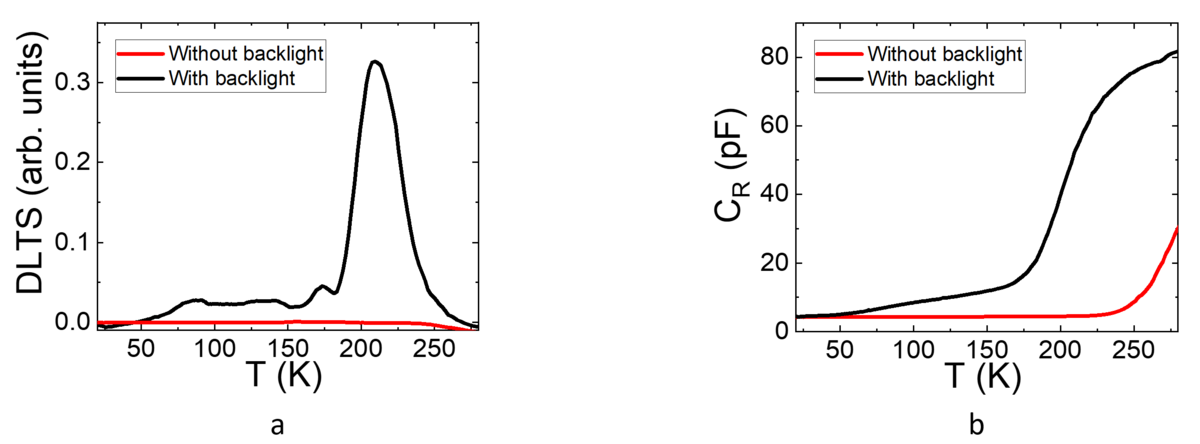
The measurements show (fig.1) that backlight illumination can help to take information from irradiated LGAD. The measurements demonstrate that background illumination provides an effective method for obtaining defect-related information directly from irradiated LGAD diodes. These results offer new insight into defect characterization in radiation-damaged semiconductor materials and will be presented and discussed at the conference.