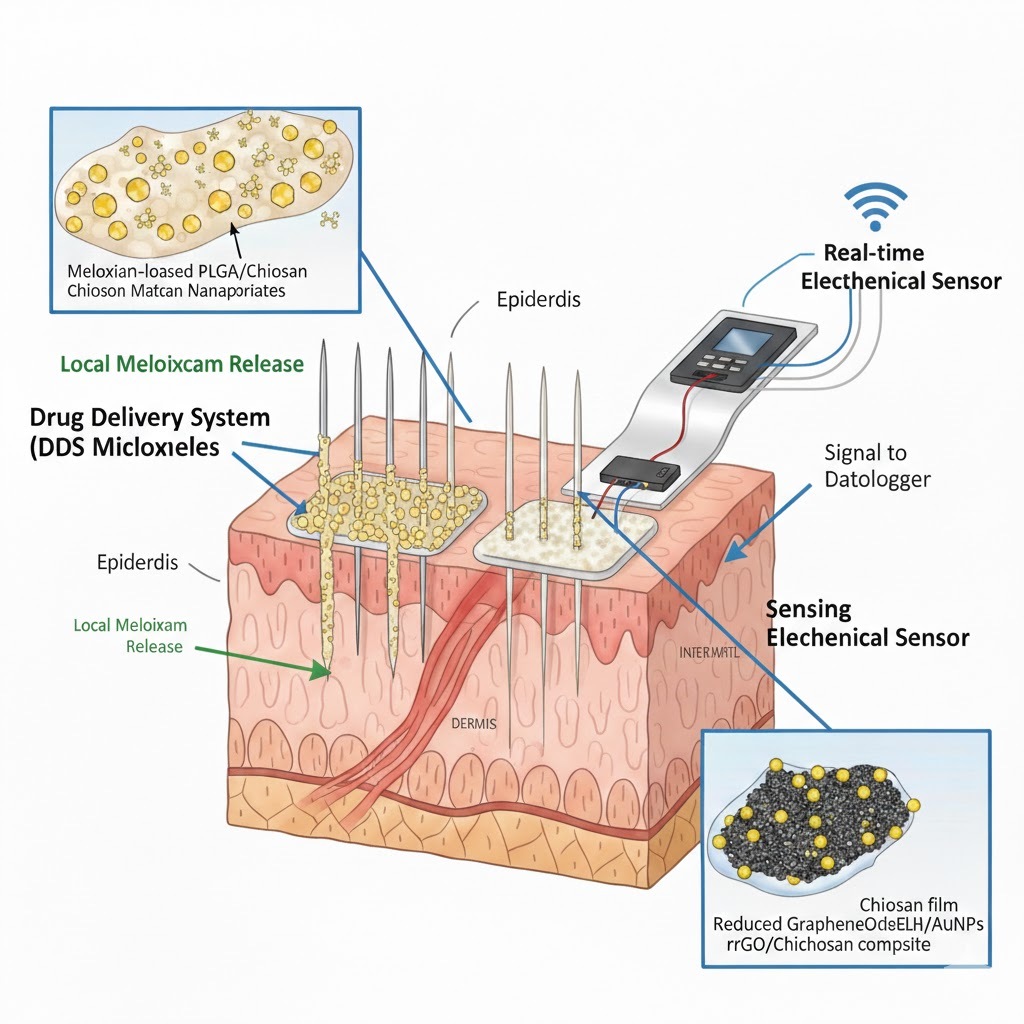
Rheumatoid Arthritis (RA) requires long-term management with Non-Steroidal Anti-Inflammatory Drugs (NSAIDs) like Meloxicam (MLX). It is a widely used NSAIDs and developing an electrochemical sensor for its sensitive detection is a strategic move to address the limitations of traditional pharmaceutical and clinical analysis [1-2]. While standard methods like High-Performance Liquid Chromatography (HPLC) are accurate, they are often time-consuming, expensive, and require sophisticated laboratory infrastructure [3]. In this work, an rGO/AuNPs electrochemical sensor for MLX is developed by the drug’s intrinsic redox activity and the clinical need for rapid, cost-effective monitoring in arthritic patients as a theragnostic microneedle system (Figure 1). By replacing traditional, labor-intensive chromatographic methods with a portable electrochemical platform, real-time dosing adjustments can be made, enhancing therapeutic efficacy while minimizing systemic side effects. In this regard, for the designing and optimum fabrication of a high-performance nanocomposite transducer layer on a Platinum (Pt) electrode surface for MLX detection, graphene oxide (GO) concentration (0.5-1.5 mg/mL), HAuCl4 concentration (0.5-2.5 mM) and deposition time (100-500 second) considered as the independent variables considering the limit of detection (LOD) for MLX as the main response. Central Composite Design (CCD), which is more powerful than a Box-Behnken Design (BBD), is selected for design experiments [4]. For 3-factor optimization, a CCD designed 20 runs, 8 Factorial Points, 6 Axial (Star) Points, and 6 Center Points. A one-step potentiostatic co-reduction method [5] employs to achieve a high-performance rGO/AuNPs interface on a Platinum (Pt) electrode. The findings and optimum procedure ensure that the GO and Gold ions (Au3+) are reduced simultaneously, creating a cohesive, 3-dimensional conductive network suitable for highly sensitive MLX detection.