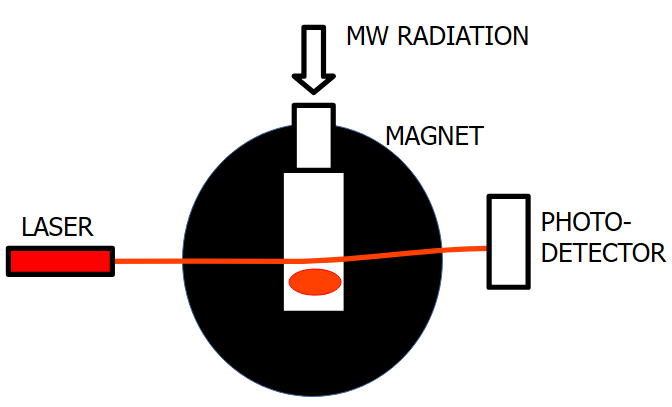
This study introduces photo-deflection electron paramagnetic resonance (EPR) spectroscopy as a new method for registering spectra of paramagnetic samples. The sample is placed in a resonance cavity and excited using microwave radiation, which is tuned via an external magnetic field to achieve resonance conditions. This process generates localized heating, creating a thermal gradient above the surface of the sample. A collimated laser beam directed through this gradient allows us to measure the deflection of the laser beam with a high-sensitivity photodetector. The resulting absorbance spectrum mirrors traditional EPR signals, with potentially enhanced sensitivity and providing new insights into thermal dynamics in materials with unpaired electrons. The implications of this technique are significant for various applications, particularly in materials science and biomedical fields, where understanding thermal behaviors at the microscopic level is crucial.