Airborne viral and bacterial diseases represent a significant risk to public health, as demonstrated by global pandemics over the past century, including the ongoing COVID-19 pandemic and recurring seasonal influenza outbreaks. These events emphasize the importance of effective technologies for improving indoor air quality and reducing microbiological air pollution, particularly in healthcare environments such as hospitals and clinics, where airborne microorganism concentrations may be elevated [1].Common mitigation strategies include ultraviolet irradiation, chemical surface disinfection, and air filtration systems. However, their effectiveness varies, and additional technologies are required to ensure reliable air decontamination. Our main aim is to develop a technology that can ensure high efficiency in reducing microbiological air pollution. Ionization devices, such as unipolar and bipolar ionizers and their various types (needle ionizers, etc.) and plasma discharge devices, can improve air quality by up to 99% [2].
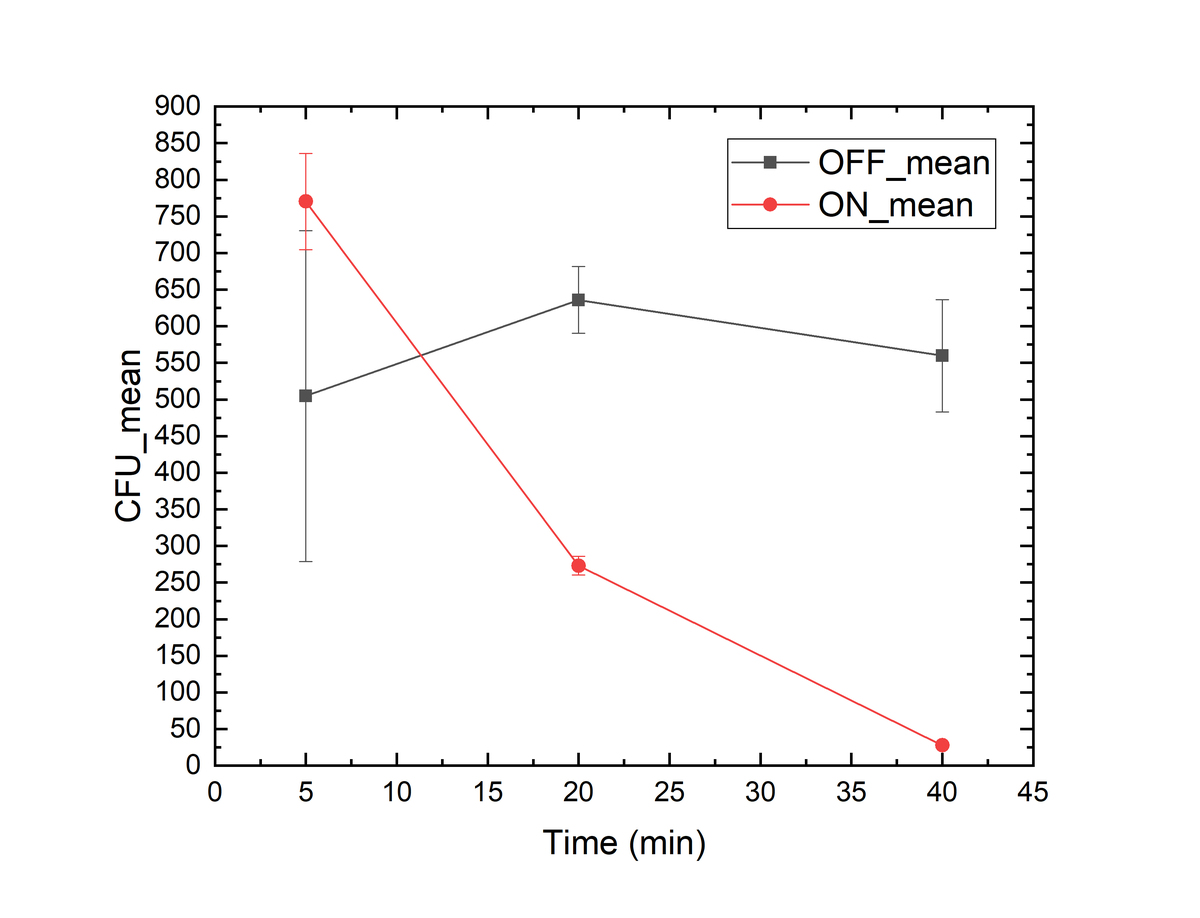
In this study, the efficiency of negative air ionization in reducing airborne bacterial contamination was investigated. A unipolar ionizer operating at a negative polarity voltage of 6 kV was used. A suspension of Lactobacillus casei containing 10\(^{9}\) CFU mL\(^{-1}\) was aerosolized into a test chamber. Air samples were collected using an impinger after 5, 20, and 40 minutes with the ionizer switched ON and OFF. Collected samples were cultured on Petri dishes, incubated, and colony-forming units (CFU) were enumerated. Results are presented as mean values with standard deviation from three replicate measurements in Fig. 1.
The results demonstrate faster reduction of airborne CFU concentrations when ionization was applied compared to natural decay observed under control conditions. Fig. 1 shows the decrease in CFU over time when the ionizer is turned ON and OFF. After 40 minutes of ionizer operation, the reduction efficiency reached 95.06%. A gradual decrease in CFU was also observed when the ionizer was OFF, which can be attributed to natural sedimentation, gravitational settling, and desiccation of airborne bacteria. Ionization technology enhances this process by promoting the attachment of charged ions to bacterial cells, inducing oxidative stress and accelerating their removal from the air.