Pharmaceutical compounds represent an important group of micropollutants of increasing concern due to their continuous release into the environment, biological activity, and potential adverse effects on aquatic ecosystems and human health [1]. These substances are widely detected in municipal wastewater; however, conventional biological wastewater treatment processes are not sufficiently effective in their removal. In response to this issue, the updated EU Urban Wastewater Treatment Directive introduces a quaternary treatment stage and identifies a list of 12 priority pharmaceutical compounds subject to monitoring and removal requirements [2]. The research, presented in this work, was funded by the EMPEREST project under the Interreg Baltic sea region programme 2021–2027. During the EMPEREST project, the impact of quaternary wastewater treatment technologies on the removal of micropollutants from wastewater was investigated. The same 12 pharmaceutical compounds, specified in the Directive, were investigated in this study, in order to assess the effectiveness of quaternary wastewater treatment technologies for the micropollutant removal. Samples were collected: untreated wastewater, after biological treatment and after each step of the quaternary treatment process: ozonation and activated carbon filtration. Pharmaceutical concentrations were determined using liquid chromatography–tandem mass spectrometry (LC-MS/MS) according to EPA Method 1694, operated in multiple reaction monitoring (MRM) mode.
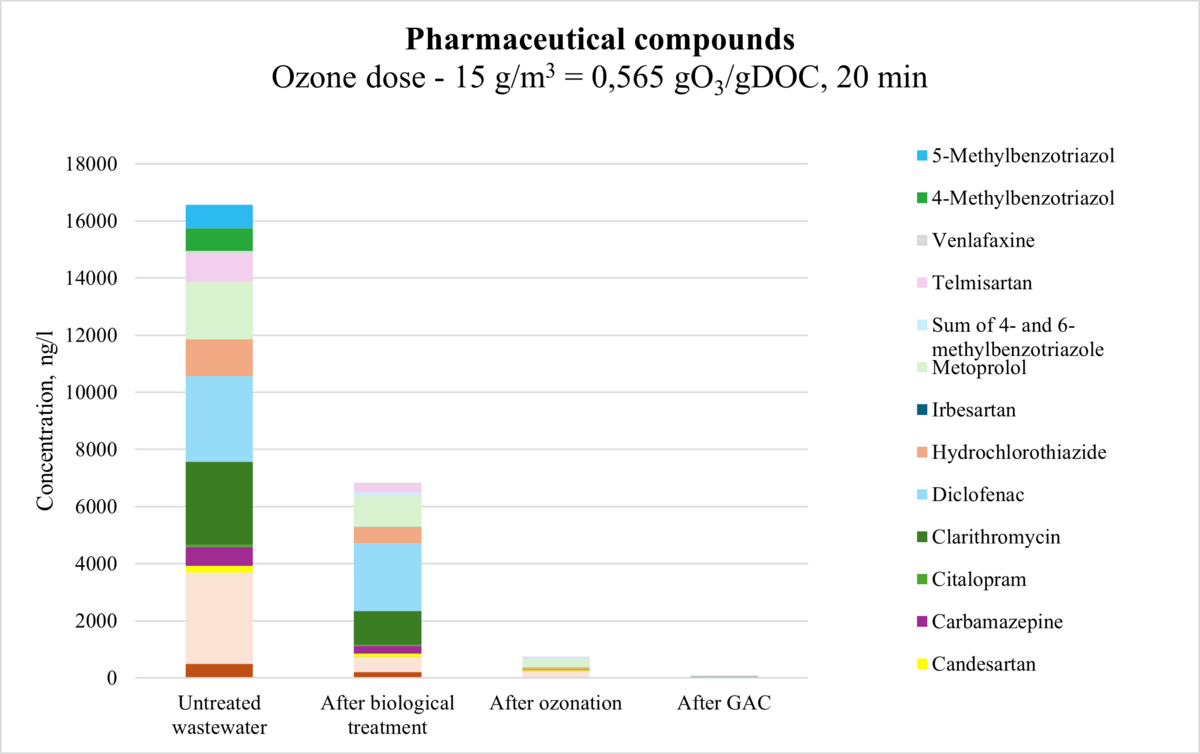
Figure 1 illustrates changes in pharmaceutical concentrations across each stage of the quaternary wastewater treatment process, along with the applied ozone dose as a key technological parameter of the ozonation process. The results demonstrate a substantial reduction in overall pharmaceutical concentrations throughout the treatment train. Biological treatment removed approximately 60 % of the investigated pharmaceutical compounds. Subsequent ozonation increased the overall removal efficiency to about 95–96 %, while the complete quaternary treatment train including GAC filtration achieved an overall pharmaceutical removal efficiency of approximately 99 %. These findings confirm that a combined quaternary treatment approach is essential for the effective removal of pharmaceutical micropollutants.