
Laser-Induced Graphene (LIG) has been widely studied in recent years. It is a porous nanomaterial produced by laser irradiation of polymer or organic materials. When appropriate irradiation parameters are applied, this method enables the formation of conductive structures in insulating substrates. LIG formation is a widely scalable technique, as laser irradiation can form conductive microstructures and process larger areas.
One possible application of LIG structures is in meta-surfaces as part of Radar-Absorbing Materials (RAM). In this work, LIG formation in Polyetherimide (PEI) material was investigated using 532 nm irradiation of nanosecond (Baltic HP, Ekspla) and femtosecond (FemtoLux, Ekspla) lasers. Laser microprocessing parameters, including irradiation power, scanning speed, and defocusing, were varied during the experiments. The sheet resistance of laser-processed samples was measured using the four-probe method. Meanwhile, the proposed meta-surface structure was modelled using CST Studio. 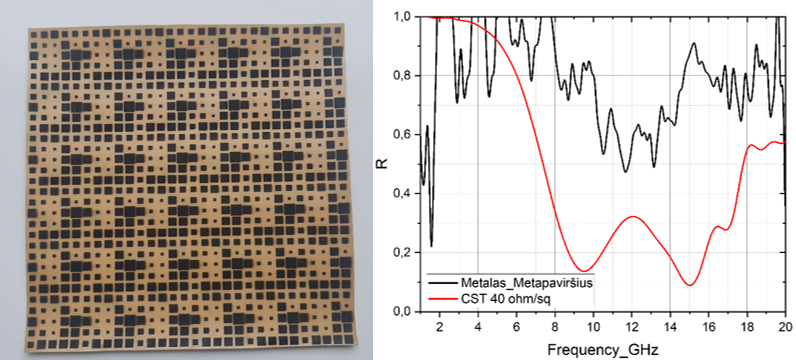
Finally, the LIG metasurface structure was fabricated and characterised in an anechoic chamber (Fig. 1). The most pronounced reduction in reflection is experimentally observed in the 8–15 GHz frequency range, which aligns well with theoretical calculations. The experimentally measured minimum reflectance reaches approximately R≈0.6, corresponding to a reflection reduction of about 3 dB (nearly twofold). The obtained results demonstrate that such graphene metasurfaces hold great promise for the development of ultrathin radar-absorbing materials (RAM) in the microwave frequency range.