Parkinson’s disease (PD) is a progressive neurodegenerative disorder closely associated with the misfolding and aggregation of α-synuclein, leading to Lewy body formation and dopaminergic neuron degeneration. As current therapies are primarily symptomatic and do not target the molecular mechanisms underlying disease progression, increasing attention has focused on modulating α-synuclein aggregation with low-molecular-weight compounds that cross the blood–brain barrier [1,2]. Despite numerous aggregation modulators reported in the literature, the set of chemically diverse, mechanistically well-characterized compounds remains limited, underscoring the need for new structural scaffolds [3].
Recent studies have identified the imidazo[2,1-b][1,3]thiazine scaffold as a promising pharmacophore for inhibiting the early stages of α-synuclein aggregation. However, its mechanisms of action remain incompletely understood [4]. This makes the scaffold particularly suitable for systematic structural modification and mechanistic investigation.
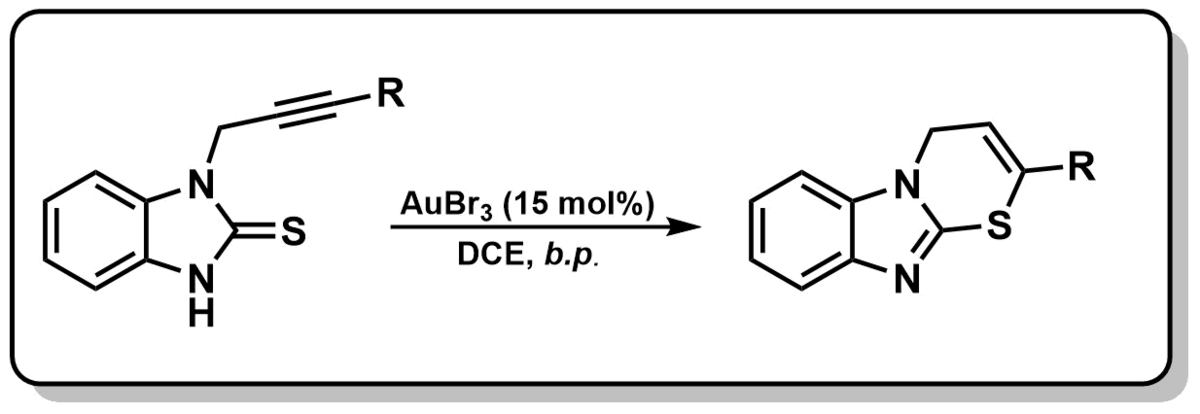
This study aimed to synthesize benzimidazo[2,1-b][1,3]thiazine derivatives capable of modulating α-synuclein aggregation. The synthesized compounds feature a novel structural modification – a substituent at the C\(_{2}\) position adjacent to the double bond. As such compounds have not been previously described in the literature, the initial objective was to establish and optimize an appropriate synthetic methodology. For this purpose, a model compound, 1-(3-phenylprop-2-yn-1-yl)-1,3-dihydro-2H-benzo[d]imidazol-2-thione, was synthesized via alkylation of 1,2-diaminobenzene with (3-bromoprop-1-yn-1-yl)benzene, followed by condensation of the resulting intermediate with thiocarbonyldiimidazole. Using this model substrate, intramolecular cyclization reaction conditions were optimized by screening various coinage catalysts and solvents to maximize selectivity for six-membered ring formation. The highest selectivity for the six-membered ring product over the five-membered ring (12:1) was achieved when the reaction was conducted in DCE using AuBr\(_{3}\) (15 mol%) as the catalyst. Based on these optimized conditions, subsequent studies systematically evaluated the influence of electron-donating and electron-withdrawing substituents on cyclization selectivity to elucidate the role of electronic effects in directing the formation of six- and five-membered ring products.