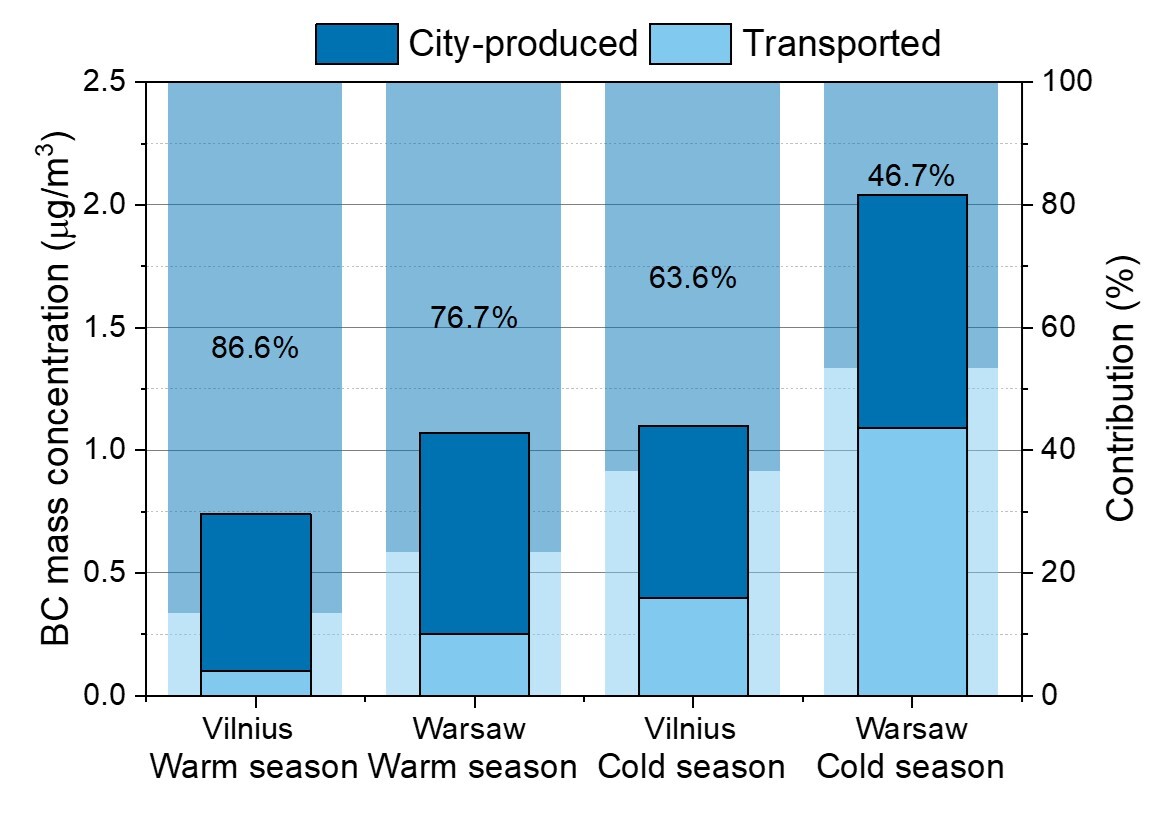
This study presents a new approach to separate urban black carbon (BC) pollution into locally produced and transported components, addressing a key challenge for effective air quality management. Cities can only directly reduce pollution emitted within their boundaries, yet measurements usually reflect a mixture of local emissions and pollution transported from other regions. To overcome this limitation, we develop a method that partitions measured BC concentrations into city-produced and transported fractions using a combination of observations and modeling [1]. We used measurement data from two simultaneous measurement campaigns (warm season 2022 and cold season 2022/23) conducted in two urban environments: Vilnius (Lithuania) and Warsaw (Poland).
During the cold season, black carbon (BC) concentrations increased substantially in both cities, being about 90% higher in Warsaw and 44% higher in Vilnius compared to the warm season. Derived aerosol properties indicate that wintertime air contained more complex mixtures of particles, including dust, BC, and brown carbon (BrC), which tended to form larger particles. We found that single scattering albedo (SSA; a measure of how particles scatter versus absorb light) decreases as BC from fossil fuel combustion increased. This relationship indicates that fossil fuel emissions amplify the warming effect of aerosols in both cities. In addition to local emissions, air mass transport also played an important role. On average, transported BC contributed 53±8% in Warsaw and 36±28% in Vilnius during the cold season, while its contribution was much lower in the warm season (23±7% and 13±21%, respectively). This means that most BC pollution – about 47% in Warsaw and 64% in Vilnius – originated from sources within the cities themselves.
Overall, the results show that winter air quality in both cities deteriorates significantly, driven by higher emissions and a stronger influence of transported pollution. These findings highlight the need for both local emission reductions and regional cooperation to effectively improve urban air quality.