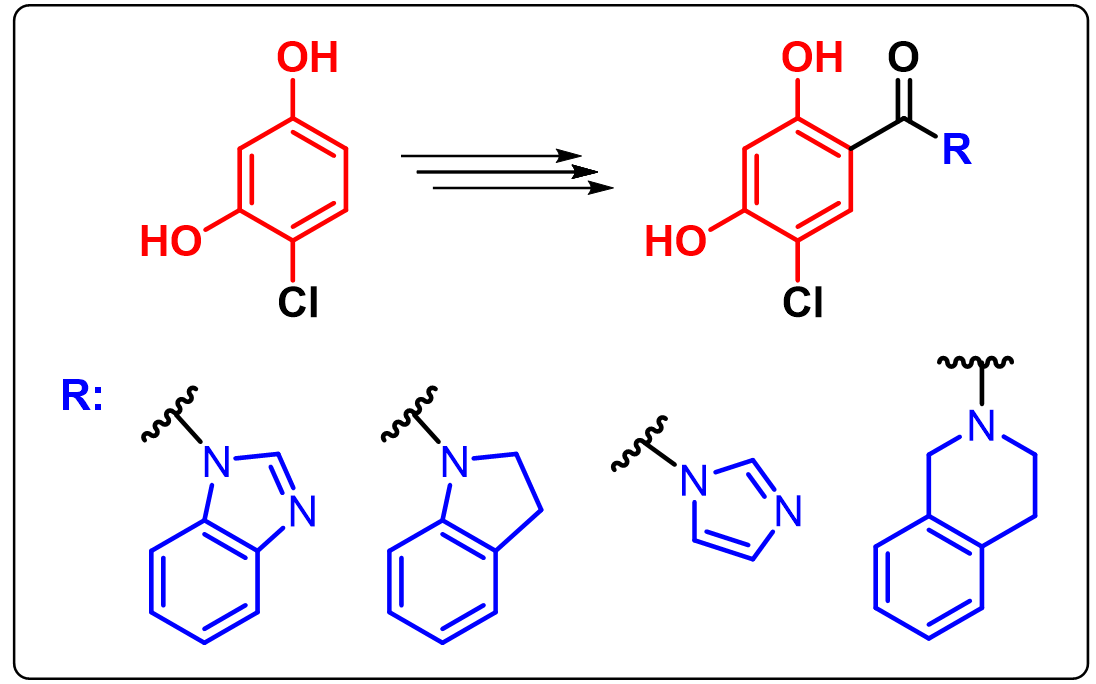
Hsp90 (Heat Shock Protein 90) is a crucial molecular chaperone that plays a key role in the maturation and regulation of more than 300 client proteins. Many of these clients are associated with challenging illnesses, including cancer, neurodegenerative disorders, and infectious diseases. As a result, Hsp90 has emerged as an important target for the development of synthetic inhibitors. A central pharmacophore in many Hsp90 inhibitors is the resorcinol fragment, which suppresses Hsp90 activity through interaction in the ATP pocket in the protein’s N-terminal domain. Therefore, resorcinol-containing compounds are extensively explored in the design of second-generation Hsp90 inhibitors [1].
To synthesize novel HSP90 inhibitors featuring a modified resorcinol structure, this study investigated synthetic routes for introducing an amide group at the 6-position of the aromatic ring. 4-Chlororesorcinol was selected as the core starting structure.
Several synthetic approaches were explored to obtain the target compounds, focusing on different strategies for functional group protection and amide formation. The initial route involved methylation of the hydroxyl groups of 4-chlororesorcinol, followed by formylation, oxidation to the corresponding carboxylic acid, and successful amide formation; however, non-selective deprotection of the methoxy groups using boron tribromide, as well as the failure of alternative deprotection methods, led to the abandonment of this strategy. Subsequently, direct amide coupling of dihydroxybenzoic acid derivatives with amines using HATU and EDCI activation systems was explored but did not yield the desired products. An alternative strategy employing acetyl protecting groups was therefore assessed and successfully validated in a model system lacking a chlorine substituent via a one-pot amide formation. However, extension of this approach to the chlorinated target was unsuccessful due to challenges associated with selective chlorination and oxidation without compromising the acetyl protections, underscoring the pronounced effect of the chlorine substituent on substrate reactivity. The advantages and limitations of the investigated synthetic approaches will be discussed during the presentation.