
Electrochemical water splitting and the oxygen reduction reaction are key processes for sustainable hydrogen and oxygen production and efficient operating of fuel cells in alkaline media, respectively. Pd based bimetallic catalysts supported on copper have emerged as promising alternatives to Pt due to their tunable electronic structure, improved activity, and reduced noble metal loading [1]. In this context, PdCo/Cu and PdNi/Cu catalysts have been shown to exhibit synergistic effects between Pd and 3d metals. These effects enhance the adsorption-desorption balance of hydrogen and oxygenated intermediates on the catalyst surface, rendering them attractive as multifunctional electrode materials capable of driving both water splitting and fuel cell systems. Therefore, studying PdCo/Cu and PdNi/Cu coatings offers valuable insights into structure–activity relationships and supports the development of efficient, durable, and cost effective electrocatalysts for next generation energy conversion devices [2]. In this study Co and Ni were electrolessly deposited on the copper surface to form Co/Cu and Ni/Cu coatings by using an electroless deposition bath at the temperature of 40 °C and morpholine borane as the reducing agent. 1 mmol PdCl\(_{2}\) solution was used for deposition of Pd nanoparticles. The composition and morphology of prepared PdCo/Cu and PdNi/Cu coatings were characterized by Field Emission Scanning Electron Microscopy (FESEM) method. The electrocatalytical properties of the PdCo/Cu and PdNi/Cu catalysts toward the hydrogen evolution, oxygen evolution and oxygen reduction reactions were investigated in an alkaline medium by using linear sweep voltammetry. Among the catalysts studied, PdCo/Cu displayed the lowest HER overpotential of 227 mV at a current density of 10 mA cm⁻² (25 °C), outperforming PdNi/Cu which required 291 mV. 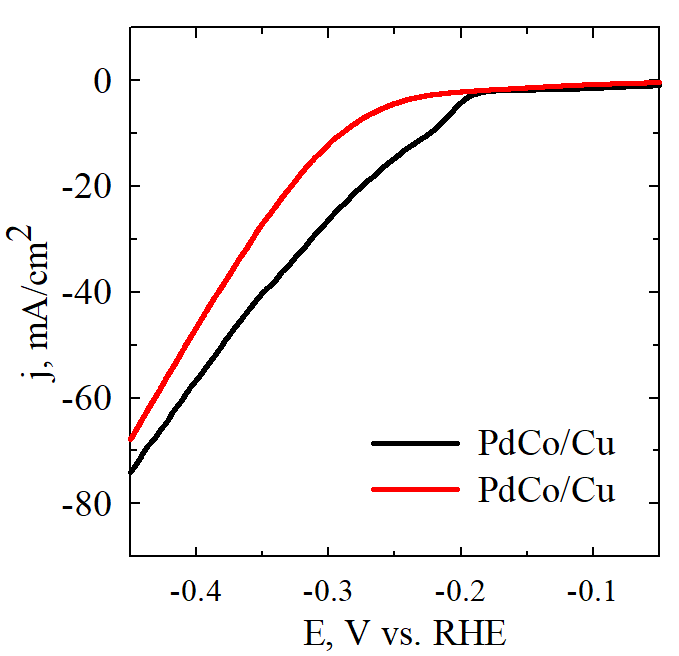
ELECTROCATALYTIC PERFORMANCE OF PdCo/Cu AND PdNi/Cu COATINGS TOWARD WATER SPLITTING AND OXYGEN REDUCTION REACTIONS
Raminta Stagniūnaitė1, Virginija Kepenienė1, Zita Sukackienė1, Loreta Tamašauskaitė-Tamašiūnaitė1
1 Center for Physical Sciences and Technology, Department of Catalysis, Vilnius, Lithuania
[1] C. Renugadevi and L. Cindrella, “Nanoscale Pd-Co alloy supported on dual heteroatoms doped carbon – An efficient electrocatalyst for hydrogen evolution and oxygen reduction reactions.,” Journal of Alloys and Compounds, vol. 1022, p. 179990, Mar. 2025, doi: 10.1016/j.jallcom.2025.179990.
[2] H. Amber et al., “PD-Modified COP and COFEP catalysts as efficient bifunctional catalysts for water splitting,” Catalysts, vol. 15, no. 11, p. 1035, Nov. 2025, doi: 10.3390/catal15111035.