Zinc oxide is widely used in the field of optoelectronics as an electron transport layer in solar cells and light emitting diodes, as transparent conductive oxide, as an active material in photoconductor-type UV photodetectors etc.[1] Its intrinsic properties such as high band gap of 3,37 eV, high optical transparency in visible region and exciton energy of 60 meV are the qualities that make this material highly applicable in optoelectronic devices. ZnO thin films, depending on the application and required quality, can be synthesized by a wide range of methods - starting from a solution-based hydrothermal method to various physical vapour deposition approaches . [2] One of the highly perspective, low-cost solution-based deposition approach for ZnO thin films is the sol-gel method. In this method, the selection of solvents, ligands, precursors and their concentrations, and crystallization temperatures play a very important role in defining structural properties of ZnO thin films. In this study, we aim to establish the correlation between synthesis parameters and ZnO structural properties and its effect on the solar cell device characteristics.
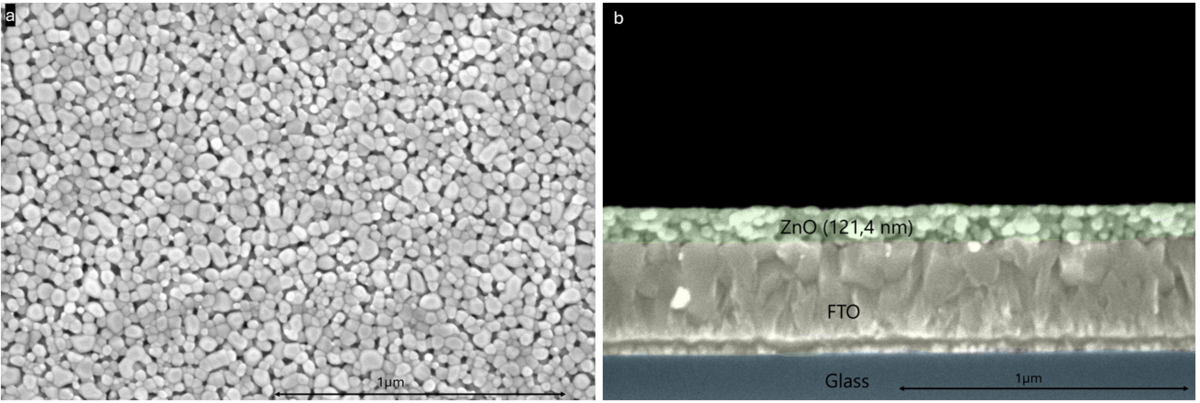
This study investigates the effects of precursor concentration (spanning from 0.3 to 0.75M) and annealing temperatures (ranging from \(400\) to \(525^\circ\)C) on the preferential crystallographic orientation and morphological changes of ZnO nanostructures. Scanning electron microscopy (SEM) has been used in determining morphology and thickness of synthesised thin films. To determine the structural phases of the zinc oxide layers, X-ray diffraction measurements were conducted employing Bragg-Brentano \(\theta\)-2\(\theta\) geometry.
The results indicate a clear correlation between intensity of dominant (002) plane and the annealing temperature, increasing the temperature leads to the increase of (002) XRD peak intensity. We also observed that increasing the concentration of precursor can lead to larger nanostructures but does not have an impact on uniformity of the film. Synthesised thin films were employed in fabricating FTO/ZnO/Sb\(_2\)Se\(_3\)/Spiro-OMeTAD/Au solar cells which demonstrated 2.7% power conversion efficiency. Further work is planned to fine-tune ZnO properties by alloying it with Mg and thus to improve heterojunction quality.