RNA chemical modifications are post-transcriptional alterations to RNA base or ribose components that serve as a crucial regulatory layer, influencing RNA stability, folding, and translation. Among the plethora of known modifications, 2′-O-methylation (Nm) is one of the most common and is found across diverse RNA species in all known domains of life, as well as in RNA viruses. In recent years, considerable progress has been made in mapping Nm sites and elucidating their biological roles [1]. However, the enzymatic pathways responsible for the catabolism of 2′-O-methylated nucleosides remain largely unexplored, as only a few bacterial nucleoside hydrolases have been characterized previously.
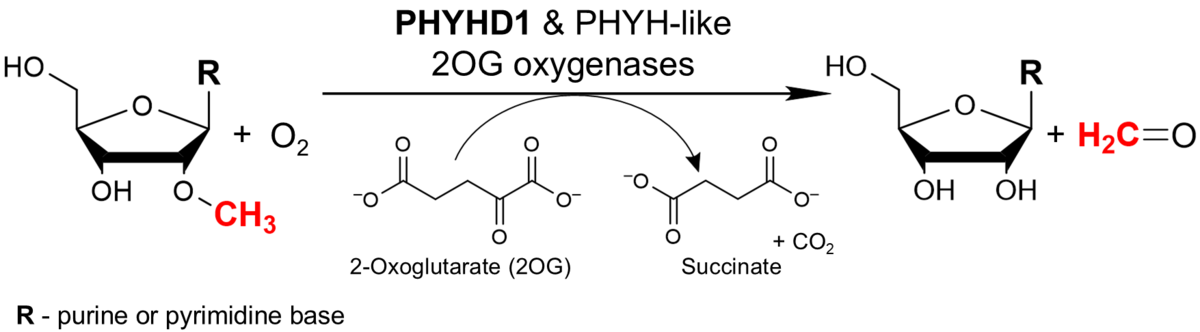
Therefore, functional screenings of metagenomic libraries were conducted to identify novel enzymes active toward 2′-O-methyl pyrimidines, using the auxotrophic Escherichia coli DH10B ΔpyrFEC strain, a method created to select for enzymes involved in the biodegradation of modified nucleosides [2]. During one of these searches, a novel 2′-O-methylated nucleoside demethylation reaction catalyzed by a bacterial 2-oxoglutarate- and Fe(II)-dependent dioxygenase FJS was identified. Following this, the same enzymatic activity was assigned to FJS-related enzymes annotated as members of the phytanoyl-CoA dioxygenase (PHYH) family or as phytanoyl-CoA dioxygenase domain-containing protein 1 (PHYHD1). Whilst human PHYH has a clearly defined function in phytanic acid α-oxidation within peroxisomes, until our study, the primary substrate of human PHYHD1 had not been identified [3].
It was found that, like FJS, eukaryotic PHYHD1 dioxygenases demethylate a broad range of ribose-methylated nucleosides but do not demethylate modified nucleotides or RNA in vitro. To determine whether the loss of PHYHD1 function affects 2′-O-methylation levels of RNA-incorporated or free nucleosides, a phyhd1 knockout (phyhd1-KO) zebrafish line was generated. While no visible phenotype changes were observed and the RNA modification levels remained unchanged, the amounts of free 2′-O-methylated inosine, guanosine, cytidine, and uridine were significantly elevated in both phyhd1-KO embryo and adult zebrafish extracts. These findings indicate that PHYHD1 does not directly demethylate RNA but instead functions in the turnover of free 2′-O-methylated nucleosides [4].Thus, a previously unrecognized metabolic pathway for 2′-O-methylated nucleosides was identified, with PHYHD1 as the key dioxygenase responsible for their demethylation.