
The nuclear industry faces a significant decommissioning challenge. It is estimated that by 2050, approximately 400 nuclear reactors will be closed and over 5 million tons of metallic scrap will be created [1]. For this reason laser ablation has been identified as a highly effective decontamination method due to its non-contact application and the reduction of secondary waste [2, 3]. However, the large-scale implementation of this technology depends on the successful mitigation of radioactive aerosol dispersion and this requires a closer look at exactly how these particles are generated [4].
In this study, aerosol size distribution and mass concentrations were characterized during the ablation of stainless and carbon steel surfaces. A nanosecond pulsed fiber laser, mounted on a linear motor stage, was used to perform controlled removal of material. Measurements obtained using a cascade impactor indicate that the resulting debris is concentrated primarily in the sub-micron range. Specifically, 80–90% of the total mass consists of ultrafine particles that are 1μm or smaller. 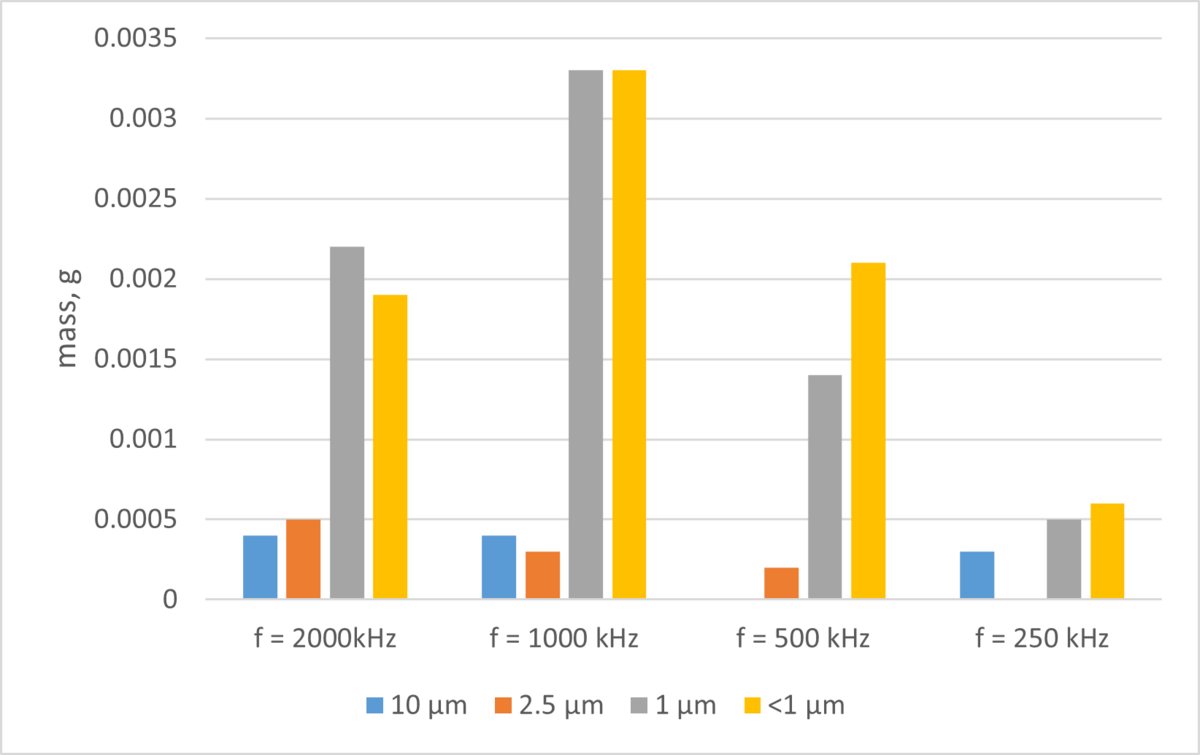
Comparative analysis reveals that surface conditions significantly influence emission volumes. The ablation of painted layers was found to generate higher aerosol concentrations than unpainted substrates, which is caused by the increase of optical absorption [2]. Furthermore, filtration tests revealed that standard vacuum filters were insufficient to contain this debris, as nanometric particles were observed passing straight through. This failure highlights the necessity of specialized high-efficiency (HEPA) filtration, which is known to effectively capture such ultrafine aerosols by leveraging their ionization-induced electrostatic charge to ensure operational safety [3, 5].