Cerium-doped aluminum garnet scintillators exhibit high light yield and strong resistance to ionizing radiation. They are used in high-energy particle physics experiments, medical diagnostics, and radiation safety applications [1]. However, these crystals are prone to the formation of antisite-type defects, which degrade the scintillation timing characteristics that are critical for their application in detector systems. One approach to addressing this issue is the growth of scintillating layer using the liquid-phase epitaxy (LPE) method, which, due to the lower processing temperatures, reduces the probability of defect formation [2]. Another approach is co-doping with Mg²⁺ ions, which introduce fast recombination pathways at the expense of reduced light yield [3].
The aim of this study is to measure and evaluate PLE grown LuAG: Ce photoluminescence parameters dependence on increasing magnesium concentration.
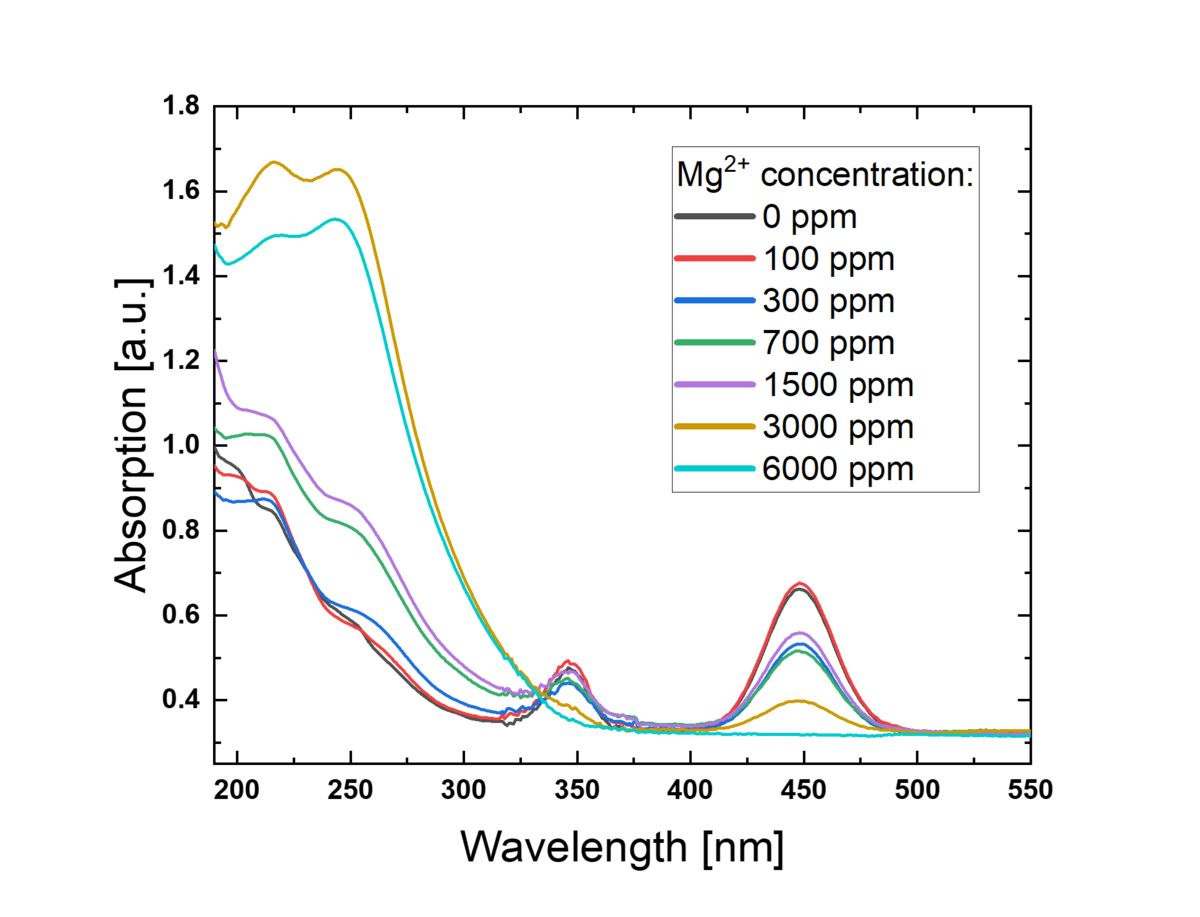
In this study, seven samples with magnesium concentrations ranging from 0 to 6000 ppm relative to lutetium were investigated. Spatial distributions of surface photoluminescence parameters were measured using a confocal scanning microscope, absorption spectra were recorded with a UV–VIS spectrophotometer, and the photoluminescence decay times of the Ce³⁺ 5d₁ level were measured using a streak camera with femtosecond laser excitation.
The obtained results indicate that increasing magnesium concentration leads to enhanced absorption in the UV spectral region, reduction of Ce³⁺ 5d\(_1\) and 5d\(_2\) absorption peaks and a shortening of the photoluminescence decay time from 57 to 0.8 ns, when magnesium concentration increases from 0 to 6000 ppm. These effects are attributed to the stabilization of cerium ions in the tetravalent state due to the influence of Mg²⁺ on charge compensation within the crystal lattice. Ce⁴⁺ ions more effectively compete with electron trapping centers for conduction-band electrons, resulting in faster scintillation decay. However, this also introduces nonradiative recombination pathways that reduce the light yield [3]. In addition, a decrease in both the density and size of hexagonal and triangular surface defects in the epitaxial layer was observed with increasing magnesium concentration. Defect size decreased from 2338 \(\mu m^2\) at 0 ppm magnesium to 314 \(\mu m^2\) at 6000 ppm magnesium. This size reduction may be influenced by changes in ionic radii within the dodecahedral sublattice [4].