Cupriavidus necator H16 is a metabolically versatile chemolithoautotroph capable of utilizing CO₂ and aromatic compounds [1]. The tyrosine-derived intermediate 4-hydroxyphenylpyruvate (4-HPPA) is a promising target for biosensor development and metabolic engineering. Here, we investigated the role of the hppD gene in 4-HPPA metabolism and its impact on inducible reporter activation.
A Δ4hppD mutant was generated via double homologous recombination using a suicide plasmid (pIK072). A red fluorescent protein (RFP) reporter plasmid (pPM014) was introduced into wild-type and mutant strains. Fluorescence responses to L-tyrosine, 4-HPPA, homogentisate, gentisic acid, and L-aspartic acid were quantified alongside growth monitoring.
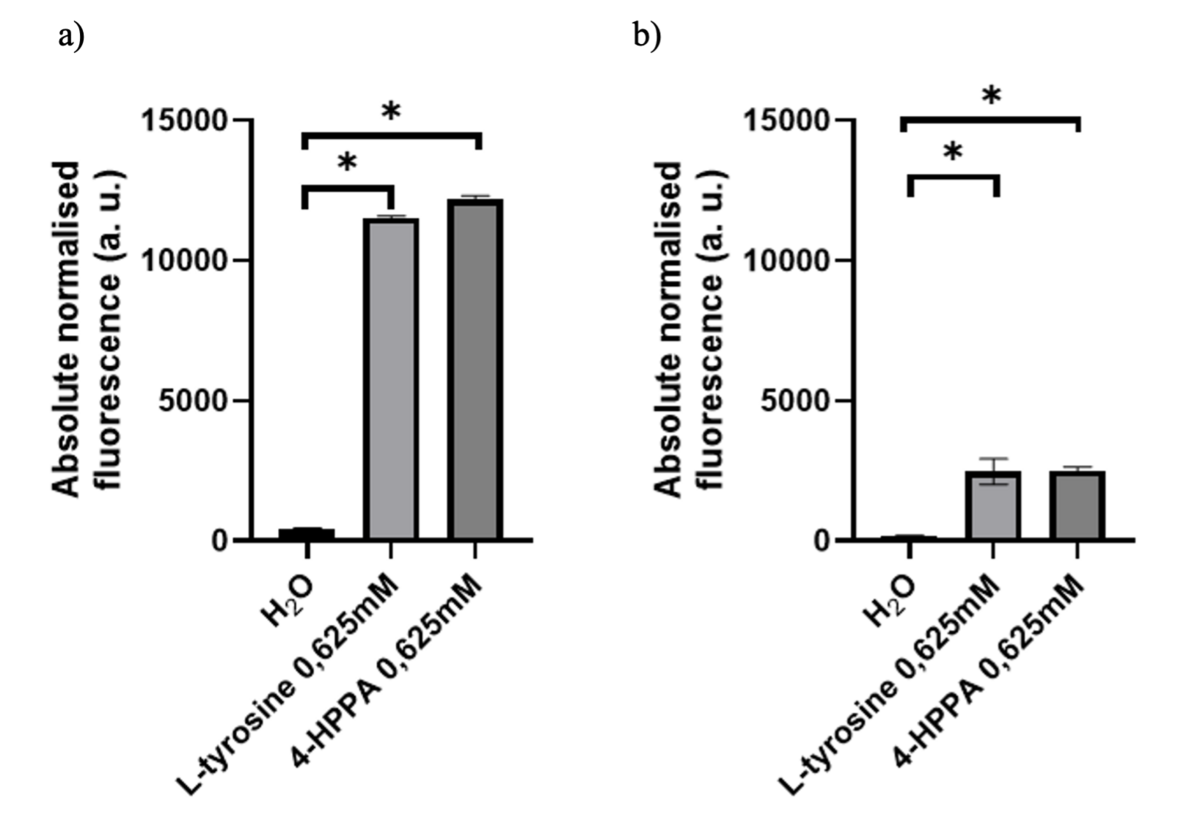
Deletion of hppD did not affect bacterial growth (final OD₆₀₀ 1.0 – 1.1) but markedly altered fluorescence induction. The Δ4hppD strain exhibited strong and sustained responses to L-tyrosine and 4-HPPA, with fluorescence intensities of 26.26 ± 4.36 and 30.90 ± 4.50 – fold, respectively (Fig. 1a). In contrast, the wild-type strain showed significantly weaker and transient responses (15.74 ± 1.92 and 16.35 ± 3.28 – fold) (Fig. 1b). Thus, fluorescence intensity in the wild type was approximately two times lower than in the Δ4hppD mutant. The prolonged induction in the deletion strain suggests intracellular accumulation of 4-HPPA due to disrupted conversion to homogentisate.
Our findings demonstrate that hppD is pivotal in controlling 4-HPPA metabolism in C. necator H16. The Δ4hppD strain represents an improved platform for 4-HPPA – responsive biosensing and metabolic engineering applications.