The growing demand for high-power, high-repetition-rate femtosecond laser systems arises from their potential to enhance signal-to-noise ratios and acquisition speeds in scientific and biomedical imaging [1-3]. However, the fixed central wavelength of most solid-state femtosecond oscillators limits their versatility. To address this, we present a pre-chirp managed rod-type Yb-doped fiber amplifier system [4] capable of generating tunable wavelength femtosecond pulses through optical parametric amplification (OPA) and nonlinear harmonic generation.
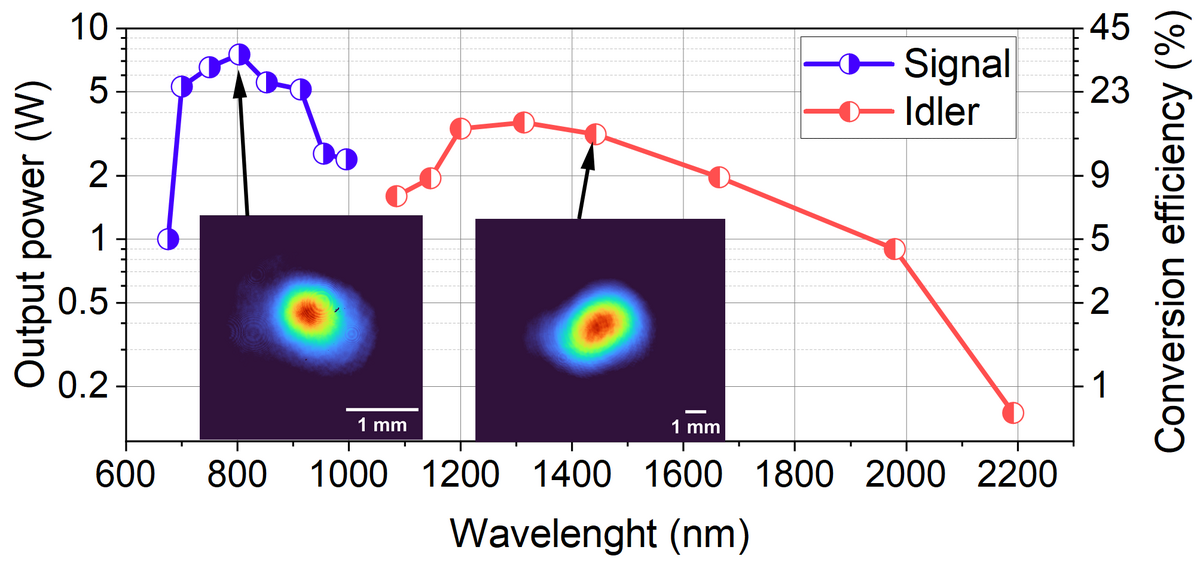
The developed OPA, based on two LBO stages pumped with 30 W of second-harmonic signal and seeded with a broadband supercontinuum from a KGW crystal, delivers tunable wavelength output from 675 nm to 2.2 μm with sub-70 fs signal and sub-100 fs idler pulses. The total output power exceeds 11 W - the highest reported for femtosecond OPAs at a 76 MHz repetition rate - with excellent stability (~1 % RMS) and low relative intensity noise (RIN) across the 1 kHz – 40 MHz bandwidth.
Further wavelength extension of femtosecond laser system is achieved through down-conversion of initial 1030 nm wavelength radiation to second (SH), third (TH), and fourth (FH) harmonic signals in BBO crystals, producing up to 41 W, 17.7 W, and 2.3 W of average power with conversion efficiencies of 60 %, 26 %, and 3 %, respectively. Generated harmonic signals exhibit nearly Gaussian shaped spatial intensity distribution with M\(^2\) value lower than 1.3 and <1 % RMS long term stability over 10 hours of continuous operation.
This versatile, high-power, tunable femtosecond laser source offers new opportunities for applications such as stimulated Raman scattering microscopy, ultrafast spectroscopy, and deep-UV imaging with enhanced spatial resolution.