Semi-empirical quantum mechanical methods based on extended tight-binding density functional theory offer similar accuracy at a computational efficiency that is 2–3 orders of magnitude faster than density functional theory (DFT) [1]. Earlier generation methods such as GFN2-xTB show limitations for redox-related applications. For example, GFN2-xTB systematically underestimates HOMO–LUMO gaps and requires empirical ionization potential and electron affinity corrections [2]. Recently developed general-purpose g-xTB method introduces fundamental theoretical improvements, achieving a weighted total mean absolute deviation of 9.3 kcal/mol on the GMTKN55 molecular dataset compared to 25 kcal/mol for GFN2-xTB [3].
This work aims to calibrate and validate the performance of g-xTB on energetic descriptors, particularly HOMO–LUMO gaps, which are central to photoredox catalyst screening. The goal is to establish whether this method can reliably determine photocatalyst ground-state properties.
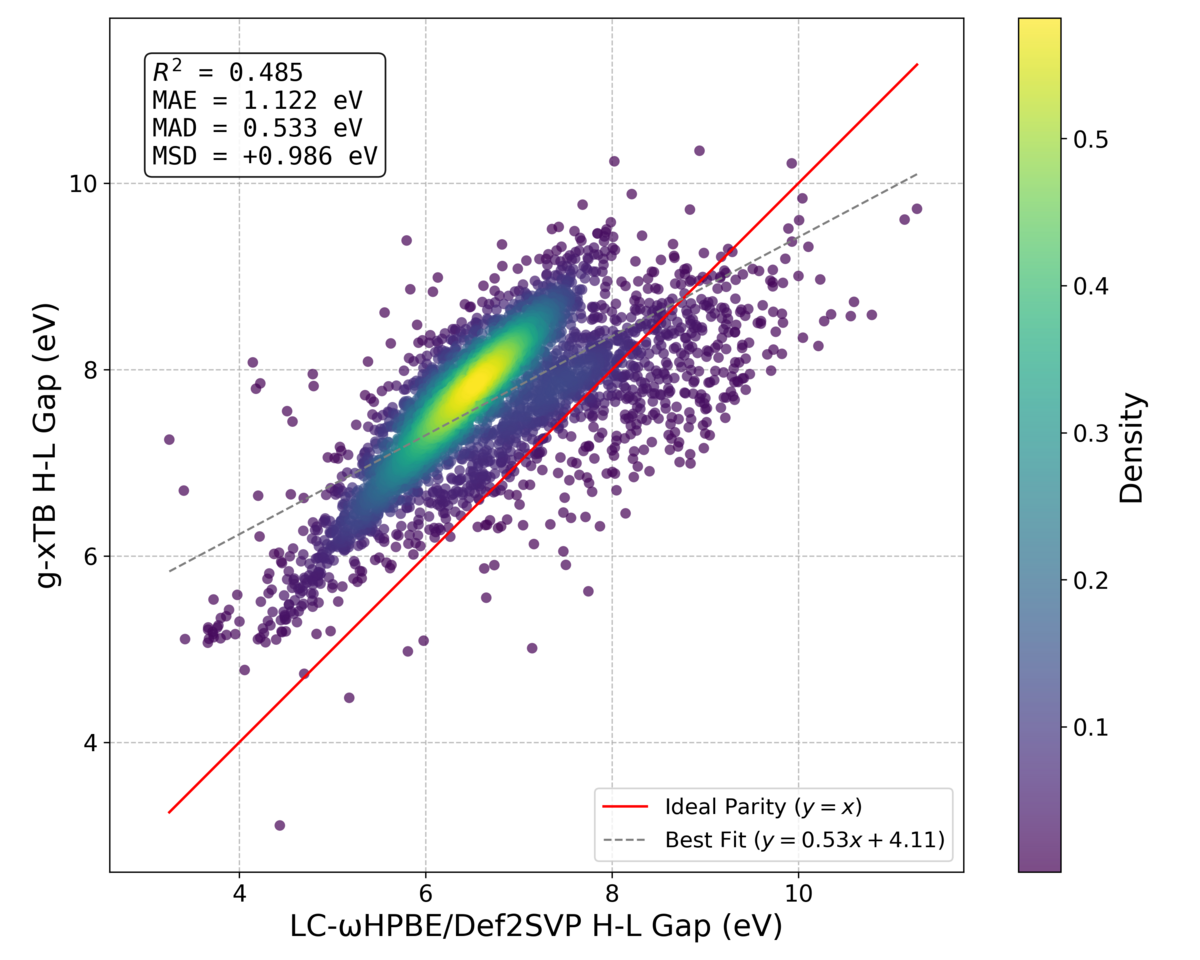
A set of organic frameworks with variable light-oriented conjugated systems from the OCELOT database were optimized using g-xTB. This benchmark set consists of 4000 neutral, ground-state, closed-shell molecules containing \(\pi\)-conjugated systems with heavy heteroatoms such as S, Cl, and I, and is planned to be extended to the full OCELOT chromophore v1 dataset size (more than 25,000 scaffolds) in the near future. The obtained HOMO–LUMO gaps were compared with those computed at the LC-\(\omega\)HPBE/def2-SVP level of theory [4]. An \(R^2\) value of 0.485 with a mean absolute error (MAE) of 1.122 eV was obtained, representing moderate correlation between the selected SQM and DFT methods and somewhat poorer accuracy of g-xTB.
Current results suggest that the g-xTB method has potential for predicting energy-related properties of organic molecules relevant to photochemical applications. Pre-screening using g-xTB can provide quick and reasonably accurate insight into structure–property relationships and is expected to become even faster once analytical gradients are implemented.