SYNTHESIS OF β-HYDROXY-α-AMINOACIDS UTILIZING L-THREONINE (TRANS)ALDOLASES
Ignas Katkevičius1, 2, Kamilė Butkutė2, Rolandas Meškys2
1 Vilnius University, Faculty of Chemistry and Geosciences, Lithuania
2 Vilnius University, Life Sciences Center, Institute of Biochemistry, Department of Molecular Microbiology and Biotechnology, Lithuania
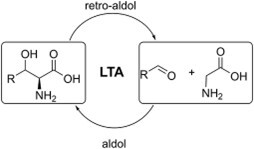
β-Hydroxy-α-aminoacids (β-HAAs) are a class of compounds widely used as intermediates in pharmaceutical synthesis (antibiotics, antiviral drugs), with the capacity to be incorporated into therapeutic peptides or functional proteins [1]. β-HAAs are typically obtained via chemical synthesis, although this process is unfavourable due to the use of several blocking groups during synthesis [2]. An alternative approach involves an enzymatic synthesis using L-threonine aldolases and transaldolases, which catalyse an aldol reaction between glycine or L-threonine and an aldehyde [3].
In this study, substrate selectivity was investigated using L-threonine aldolases from Neptunomas marina and Cellulosilyticum sp. (NmLTA and CsLTA) and L-threonine transaldolase from Pseudomonas fluorescens (ObiH). The substrate scope was evaluated using whole-cell biocatalysis, discovering that among the 23 aldehydes tested, 9 were suitable substrates for at least one enzyme. The analysis of enzymatic reactions showed that NmLTA and CsLTA catalyse the aldol reaction with pyridine-carbaldehydes (13-22%) as well as large aromatic aldehydes (3-7%), while ObiH was also active towards formyl-indoles (44-84%).
[1] Chen, Q., Wang, J., Zhan g, S., Chen, X., Hao, J., Wu, Q., & Zhu, D. “Discovery and directed evolution of C–C bond formation enzymes for the biosynthesis of β-hydroxy-α-amino acids and derivatives”. Critical Reviews in Biotechnology., Vol. 44, Issue 8, pp. 1495–1514. 2024.
[2] He, Y., Li, S., Wang, J., Yang, X., Zhu, J., Zhang, Q., Cui, L., Tan, Z., Yan, W., Zhang, Y., Tang, L., Da, L. T., & Feng, Y. “Discovery and Engineering of the l-Threonine Aldolase from Neptunomonas marine for the Efficient Synthesis of β-Hydroxy-α-amino Acids via C-C Formation”. ACS Catalysis., Vol. 13, Issue 11, pp. 7210–7220. 2023.
[3] Wang, S., & Deng, H. “Peculiarities of promiscuous L-threonine transaldolases for enantioselective synthesis of β-hydroxy-α-amino acids”. Applied microbiology and biotechnology., vol. 105, no. 1, pp 1-11. 2020.
[4] [4] Fesko, K. “Comparison of L-threonine aldolase variants in the aldol and retro-aldol reactions”. Frontiers in Bioengineering and Biotechnology., vol. 7,pp 1-12. 2019.