
Multiphoton printing (MPP) is a maskless, high-resolution 3D printing technique that exploits nonlinear light–matter interactions to induce localized polymerization in photosensitive materials, resulting in an ellipsoidal volume pixel known as a voxel [1]. Owing to its nonlinear nature, MPP allows dynamic modulation of the printing intensity, an approach commonly referred to as grayscale MPP, enabling precise control over voxel dimensions and fabricated geometry and particularly relevant for optical applications that require high structural fidelity [2].
Here, grayscale MPP was used to fabricate multilevel pixelated diffractive optical elements (DOEs) that manipulate the phase of transmitted light. The DOEs were designed from digital grayscale phase masks generated using computer-generated holography methods [3] to produce target far-field intensity distributions. During fabrication, each grayscale pixel was translated into a discrete height level by adjusting the local laser exposure dose, resulting in quasi-2.5D surface relief profiles. The fabricated structures achieved a minimum lateral pixel size of 2 x 2 µm\(^{2}\) and comprised eight discrete height levels with a step height of approximately 80 nm. Surface topography and fabrication quality were characterized using optical profilometry and scanning electron microscopy, respectively (see Fig. 1, top). Optical characterization confirmed that the printed DOEs generate the intended far-field intensity distributions (see Fig. 1, bottom).
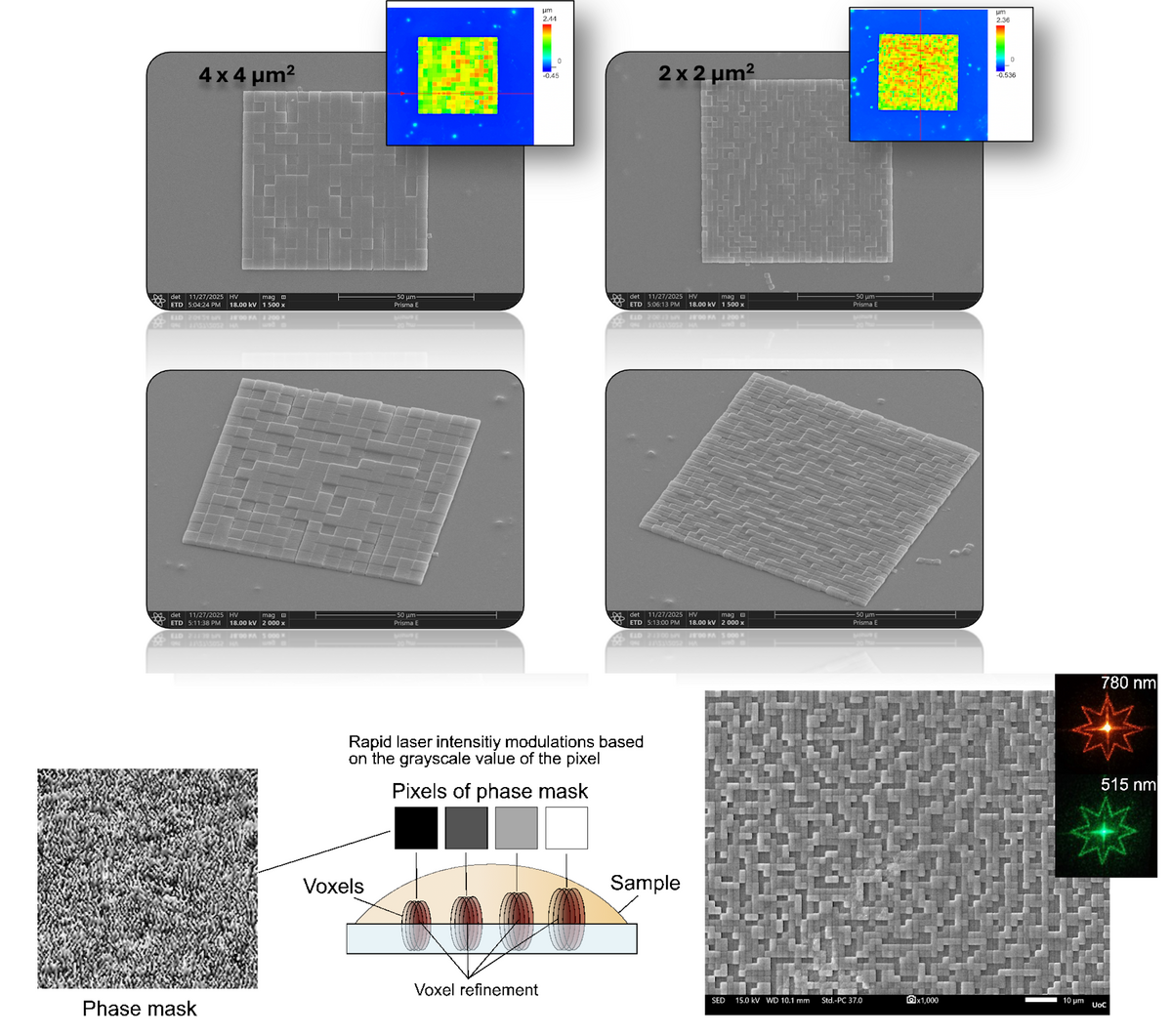
These results demonstrate that maskless grayscale MPP provides a flexible and cost-effective alternative to conventional lithographic techniques for the rapid fabrication of custom-designed DOEs, with potential applications in optical microscopy, laser beam shaping, and integrated optical systems [4].