Hydrogen fuel cells are attracting considerable attention due to their ability to convert the chemical energy stored in hydrogen molecules into electrical energy without releasing harmful by-products into the environment. During electrochemical reactions, hydrogen is reduced to protons and oxygen is oxidized into ions, which generates an electric current and produces only heat and water [1]. This method of electricity generation helps to combat climate change because the energy produced is green. Solid oxide fuel cells (SOFCs) are highly efficient compared to other fuel cells, but their wide application is limited by their high operating temperature [2]. Reducing the operating temperature while maintaining high efficiency is a clear objective for materials scientists [3]. In this work, the electrolyte, which is responsible for ion conductivity in the cell, nanopowders are synthesized using two different chemical routes and the properties are compared respectively.
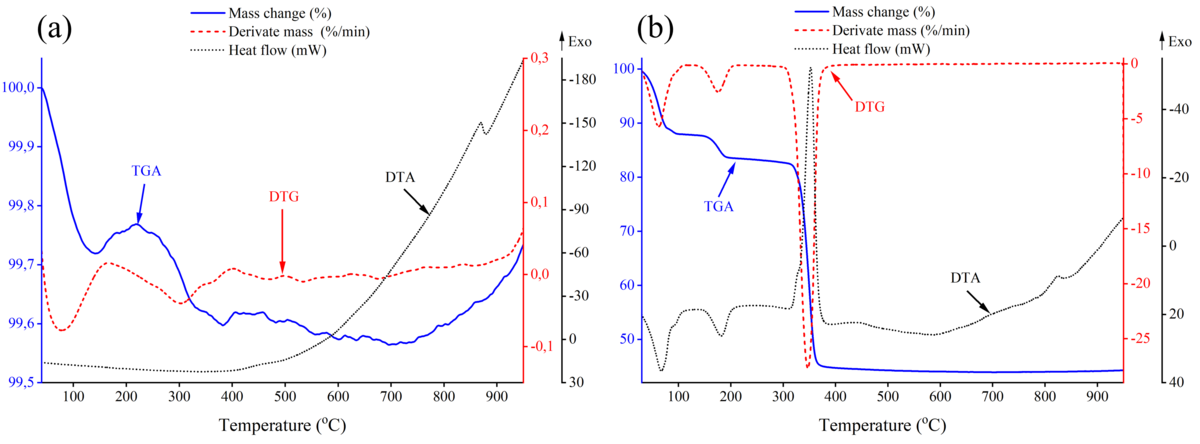
The electrolyte material is prepared by chemically synthesizing samarium and gadolinium oxide impurities into cerium oxide, obtaining nanopowders with stoichiometric formula of Ce\(_{0.825}\)Sm\(_{0.0875}\)Gd\(_{0.0875}\)O\(_{2-\delta}\) (SGDC). Two different synthesis methods are used: glycine-nitrate precursor combustion and oxalate precursor co-precipitation. The produced nanopowders are examined using an X-ray diffractometer (XRD), a scanning electron microscope (SEM) and combined thermogravimetric and differential thermal analysis (TG/DTA). It has been determined that the synthesized powder must be calcinated to at least 700 °C for the crystal lattice to fully form and for the chemical residues from the synthesis to disappear (Fig. 1). It was found that nanomaterials obtained by co-precipitation reaction are more homogeneous and have a smaller average grain size than those obtained by combustion reaction. The results show that the choice of synthesis route influences the properties of the synthesized powders and must be taken into account when planning fuel cell production.