The S100A family consists of 24 calcium-binding proteins that participate in a wide range of cellular processes, including regulation of cell signaling, immune responses and other vital functions. Dysregulation of S100A proteins has been associated with inflammatory and neurodegenerative diseases [1], [2]. S100A8 and S100A9 are known to form amyloid-like oligomers, fibrils or amorphous aggregates [3], whereas the stability of S100A12 under physiological conditions is unknown, but has been proposed to exhibit moonlighting chaperone behavior as a secondary function [4]. Therefore, we investigated whether S100A12 can alter or inhibit the aggregation behavior of S100A8 and S100A9.
Protein aggregation was monitored in vitro using the amyloid-specific Thioflavin T (ThT) fluorescent probe in a microplate reader in the presence or absence of calcium ions. Protein thermal stability was determined by differential scanning fluorimetry (DSF) by monitoring the fluorescence of the 8-anilinonaphthalene-1-sulfonic acid (ANS) dye.
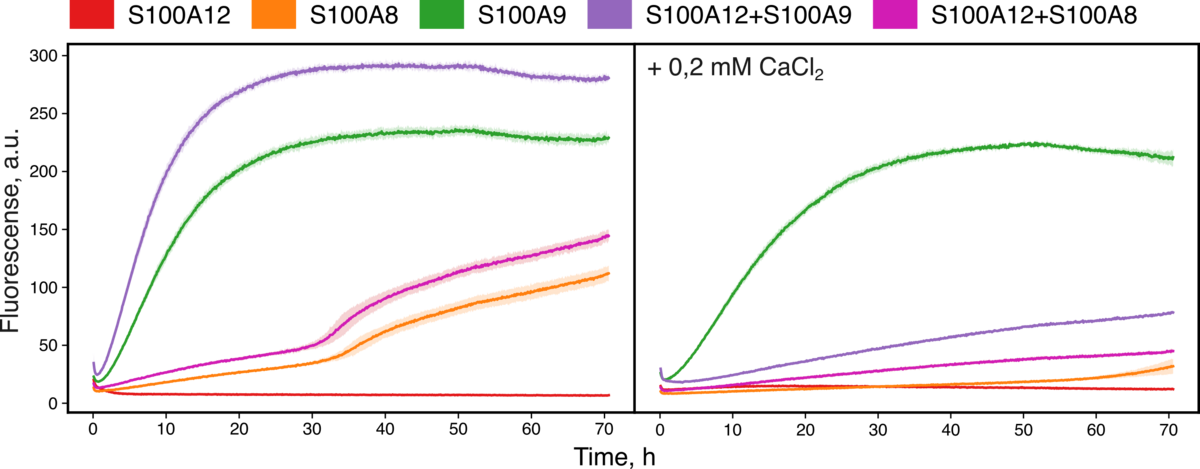
The results (Fig. 1) showed that in the absence of \(Ca^{2+}\), S100A9 rapidly formed fibrils and S100A8 aggregated more slowly, matching previously reported data [3], whereas the S100A12 sample exhibited no increase in ThT fluorescence, indicating a lack of amyloid formation. On the other hand, co-incubation with S100A12 significantly reduced the aggregation of S100A9 in the presence of \(Ca^{2+}\), while altering the aggregation of S100A8. Furthermore, the melting temperature of S100A12 was higher than that of S100A8 and S100A9, in agreement with the aggregation experiments. Overall, these results suggest that S100A12 can modulate the aggregation behavior of the S100A protein family and is a stable protein.