
Heavy metal toxicity is a significant health concern arising from the accumulation of elements that the human body cannot effectively excrete. Even prolonged, low-level exposure to Cd can lead to fatigue, cognitive impairment, and damage to the kidneys, liver, and nervous system [1]. In this study, carboxyl-functionalized silver nanoparticles were employed, which exhibited detectable spectral changes in the presence of Cd\(^{2+}\) ions, as measured using UV-Vis spectroscopy and surface-enhanced Raman scattering (SERS) techniques.
Silver nanoparticles (Ag NPs) were prepared using the citrate reduction method and subsequently functionalized with 4-mercaptophenylacetic acid (MPAA) [2], providing carboxyl groups for effective Cd\(^{2+}\) cations binding. UV-Vis spectroscopy and high-resolution transmission electron microscopy (HR-TEM) verified the formation of spherical nanoparticles and enabled estimation of their average size (50 ± 5 nm) (Fig.1A).
In the presence of metal cations, carboxyl-functionalized silver nanoparticles bind ions and form Ag-MPAA-Me-MPAA-Ag complexes (Fig. 1B). This interaction reduces the interparticle distance, leading to nanoparticle aggregation and a strong enhancement of the MPAA Raman signal (Fig. 1C). As a result, low cation concentrations can be detected using the SERS technique. 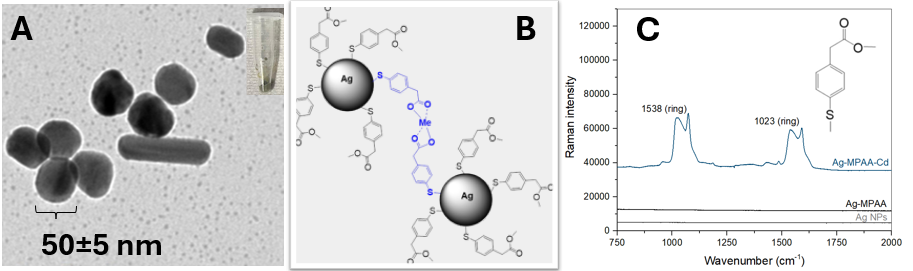
In this study, a detection limit of 10\(^{-11}\) M Cd\(^{2+}\) was determined by the SERS method, using synthesized and modified silver nanoparticles.