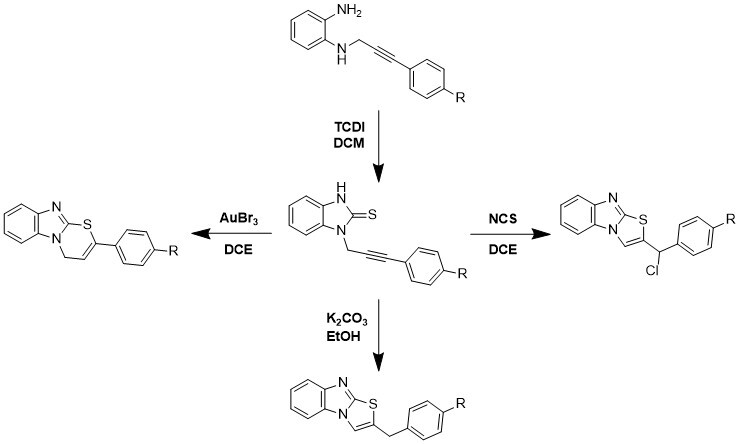
Amyloid fibril formation is a common pathological feature of protein-misfolding disorders, where nucleation-dependent aggregation can generate heterogeneous intermediates such as oligomeric species, before mature cross-beta fibrils accumulate [1]. In synucleinopathies such as Parkinson’s disease, the presynaptic alpha-synuclein undergoes misfolding, oligomerization and fibrillization, contributing to cellular stress pathways and progressive neurodegeneration [2], [3]. Because toxic effects are frequently linked to early assemblies rather than mature fibrils, targeting the aggregation pathway with small-molecule compounds is a promising therapeutic direction [1], [2]. Among emerging scaffolds, imidazo[2,1-b][1,3]thiazine derivatives were shown to inhibit primary nucleation and stabilize alpha-synuclein oligomeric states [4]. The pharmacophore could be a promising source of derivatives for modulating amyloid aggregation. This study aims to synthesize and characterize different benzimidazothiazines and appropriate thiazoles with potential amyloid aggregation reducing activity.
Firstly, the starting compound, a benzoimidazole-2-thione intermediate, was synthesized via the thiocarbonylation and intramolecular cyclocondensation of N-propargylated diaminobenzene with thiocarbonyldiimidazole. Multiple reaction pathways were chosen to produce the following compounds. Base-mediated intramolecular nucleophilic cyclization favors the formation of the benzoimidazothiazole core. Alternatively, electrophilic halocyclization with NCS produces a similar chlorinated derivative. Finally, the benzoimidazothiazine core was achieved through metal-activated intramolecular cyclization with gold(III) bromide.