Triplet–triplet annihilation photon upconversion (TTA-UC) enables conversion of two low-energy photons into one higher-energy photon using a sensitizer/annihilator pair, offering routes to improved photocatalysis [1], bio-optical applications [2], and solar utilization [3].
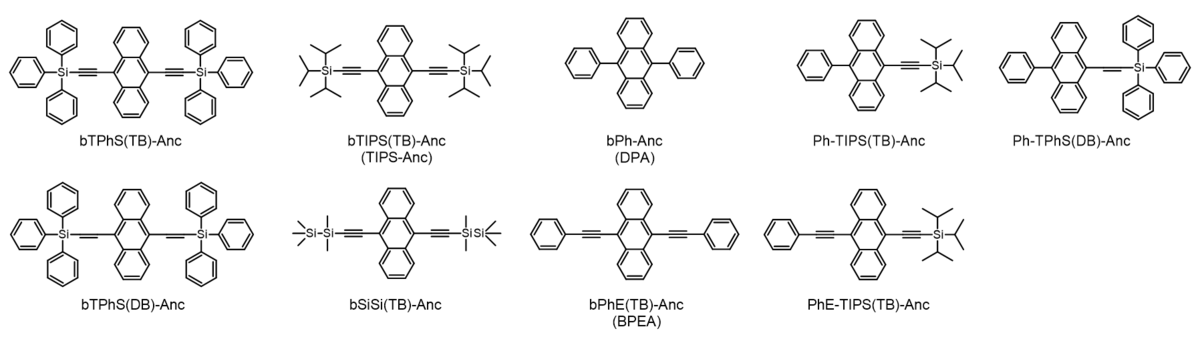
Anthracene derivatives are among the most widely investigated TTA-UC annihilators, yet predictive design rules connecting substitution patterns to UC efficiency remain incomplete. This study aims to investigate how systematic structural modifications of anthracene annihilators (Fig. 1) affect the photophysical properties governing TTA-UC. A commonly used PtOEP was selected as the triplet sensitizer, with its relatively high triplet energy (1.94 eV), while explicitly accounting for sensitizer-related losses such as reabsorption/inner-filter effects. Steady-state spectroscopy and time-resolved upconversion/phosphorescence measurements reveal that increasing linker rigidity from a vinyl (C=C) to an ethynyl (C≡C) motif sharpens vibronic structure and narrows emission spectra, consistent with reduced conformational disorder. This substantially increases UC quantum yield from 3.9% for bTPhS(DB)-Anc to 15.6% for bTPhS(TB)-Anc. In general, symmetric 9,10-disubstituted anthracenes show higher fluorescence quantum yields and larger spin-statistical factors f (≥ 0.40), supporting reduced non-radiative losses and more productive triplet-pair pathways.