
High‑energy picosecond lasers are in demand for satellite laser ranging, high‑efficiency materials processing, and laser cosmetology. Stimulated Brillouin scattering (SBS) provides a cost‑effective means of compressing nanosecond pump pulses while maintaining high output beam quality through phase conjugation. Previously, SBS-compressed, phase conjugated high‑energy pulses of ~90 ps were demonstrated in C\(_{8}\)F\(_{18}\) [1]. This work aims to compare the performance of HT‑230 and C\(_{8}\)F\(_{18}\), two photodissociation‑resistant and non‑toxic Brillouin‑active liquids used as coolants in the semiconductor industry [2]. The HT-230 medium appears most promising for ultimate compression of 890 ps pump pulses due to its short acoustic phonon lifetime of 0.3 ns.
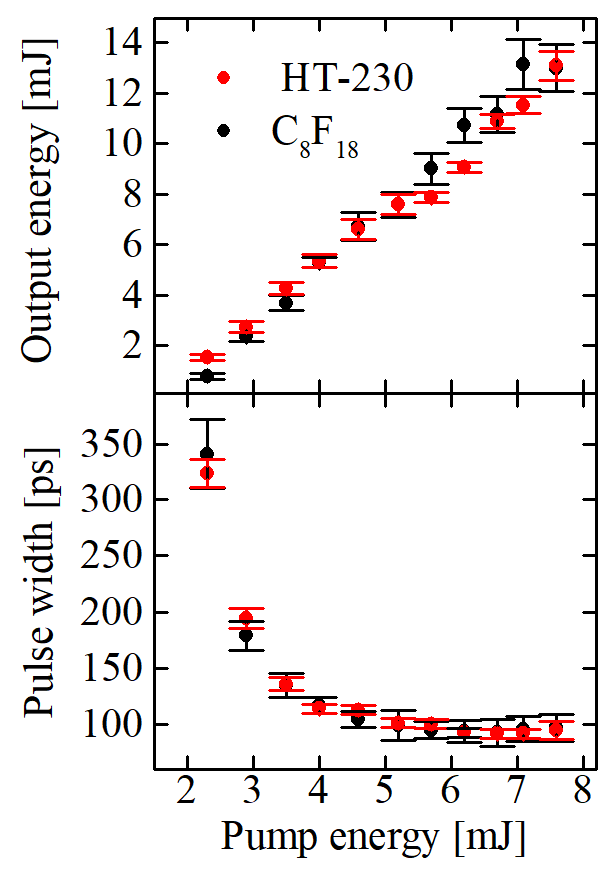
Incident pulses from a passively Q‑switched Nd:YAG laser were spatially cleaned and amplified using two side‑diode‑pumped gain modules. The counter‑propagating, compressed Stokes pulses were amplified in the second path. The focusing and pumping conditions were optimized to achieve the best pulse compression (Fig. 1a). As a result, using an f = 200 mm focusing lens at a pump energy of 6.2 mJ, the incident pulses were compressed to ~90 ps in both media (Fig. 1b). Although the higher reflectivity in C\(_{8}\)F\(_{18}\) enabled nearly 11 mJ of output energy, compared with ~9 mJ from HT-230, pulses compressed in this way were less stable. Effective suppression of amplifier‑induced aberrations and astigmatism was demonstrated in both media due to phase conjugation. Although the achieved pulses already exceed the requirements of cosmetology, future efforts will focus on nonlinear compression down to a few picoseconds for metal processing.