
Polylactic acid (PLA) composites reinforced with hydroxyapatite (HAp) are widely investigated for biodegradable bone-related applications. Nevertheless, achieving a uniform dispersion of HAp within filaments without compromising their extrusion processability remains a significant challenge. Uniform dispersion is critical for ensuring consistent mechanical performance and reliable 3D printing behavior. Moreover, optimizing the filler content can directly influence thermal properties, melt flow characteristics, and the overall structural integrity of printed scaffolds. The aim of this work was to develop PLA/HAp composite filaments with improved filler dispersion and suitable extrusion behavior. To achieve this, a solution-based mixing step was applied prior to filament fabrication, followed by melt extrusion of composites containing 5-30 wt% HAp. The composites were characterized using Fourier-transform infrared spectroscopy (FTIR), X-ray diffraction (XRD), scanning electron microscopy (SEM), melt flow rate (MFR) measurements, and tensile testing. SEM revealed that solution-based mixing produced a more uniform dispersion of hydroxyapatite (HAp) at low and moderate filler loadings. At higher HAp contents, filler-rich regions became more pronounced, reflecting the natural tendency of inorganic particles to agglomerate at elevated concentrations. These microstructural features correlated well with trends observed in thermal behavior, melt flow properties, and mechanical performance. 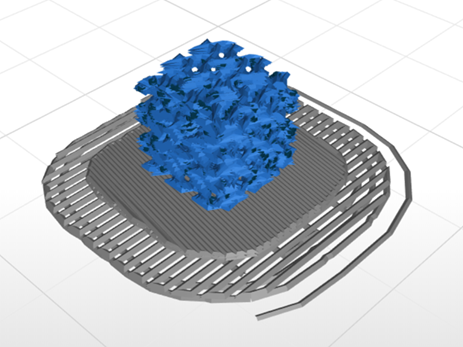
Overall, the findings provide practical guidance for fabricating PLA/HAp composite filaments and scaffolds for biomedical applications. The scaffold was printed according to the model shown in Figure 1, and among the compositions studied, PLA/HAp filaments with 20 wt% HAp exhibited the most balanced combination of structural uniformity and filament processability.