
The direct coupling of two unfunctionalized molecules under mild conditions embodies an ideal in synthetic chemistry. In this study, we report a metal-free photocatalytic process for arene C-H functionalization that employs an acridinium-type catalyst and produces dihydrogen as the only by-product. Throughout the catalytic cycle, the catalyst acts as an oxidizing agent, a hydrogen atom transfer agent, and a proton-reducing agent, enabling a cross-dehydrogenative transformation without the need for external oxidants. The reaction is conveniently performed using visible light, and the high oxidation potential of the catalyst allows it to engage even electron deficient arene substrates. The catalytic mechanism disclosed herein can become a general logic for developing various cross-dehydrogenative reactions adaptable for pharmaceutical and material sciences. 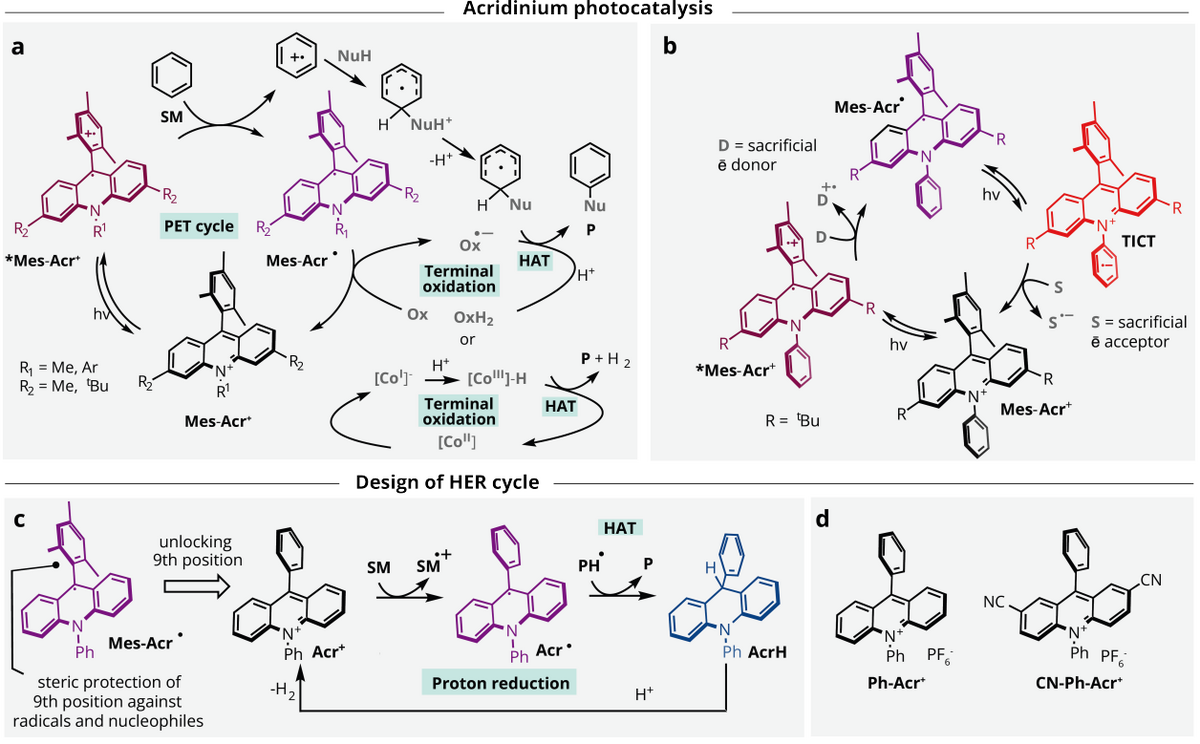
PHOTOREDOX MANIFOLD FOR DEHYDROGENATIVE COUPLING USING PROTONS AS OXIDANTS
Jonas Žurauskas1, Paulius Vaickūnas1, Gustautas Snarskis3, Nojus Radzevičius1, Barbara Chatinovska1, Gediminas Kreiza2, Steponas Raišys2, Mantas Šimėnas2, Vidmantas Kalendra2, Kęstutis Zakarauskas4, Karolis Kazlauskas2, Edvinas Orentas1
1 Vilnius University, Department of Organic Chemistry, Vilnius, Lithuania
2 Vilnius University, Faculty of Physics, Vilnius, Lithuania
3 Biomatter, Business Stadium West, Vilnius, Lithuania
4 Lithuanian Energy Institute, Kaunas, Lithuania
Acknowledgments: Financial support for this work was provided by the “Universities Excellence Initiative” programme by the Ministry of Education, Science, and Sports of the Republic of Lithuania under the agreement with the Research Council of Lithuania (project No. S-A-UEI-23-6). This work was partially supported by the project "Industry 4.0 Lab Platform: EDIH VILNIUS" Nr. 02-016-P-0002. We thank the Arqus Talent Scholarship Fund for fellowship support for J.Ž.
[1] Žurauskas, J. et al. Electron-poor acridones and acridiniums as super photooxidants in molecular photoelectrochemistry by unusual mechanisms. Angew. Chem. Int. Ed. 62, e202307550 (2023).
[2] X. Yang et al., “Toward organic photohydrides: Excited-state behavior of 10-methyl-9-phenyl-9,10-dihydroacridine,” J. Phys. Chem. B, vol. 117, pp. 15290–15296, 2013.
[3] N. A. Romero, K. A. Margrey, N. E. Tay, and D. A. Nicewicz, “Site-selective arene C–H amination via photoredox catalysis,” Science, vol. 349, pp. 1326–1330, 2015.