Laser-induced X-rays are of particular interest due to their potential as unique X-ray sources for time-resolved applications due to inherited ultrashort pulse duration. The generation of X-rays starts with laser light ionizing the metal atoms by the electromagnetic field. The produced free electrons are then further accelerated in the electric field to energies comparable to X-rays, which is then generated through characteristic radiation or bremsstrahlung (braking radiation).
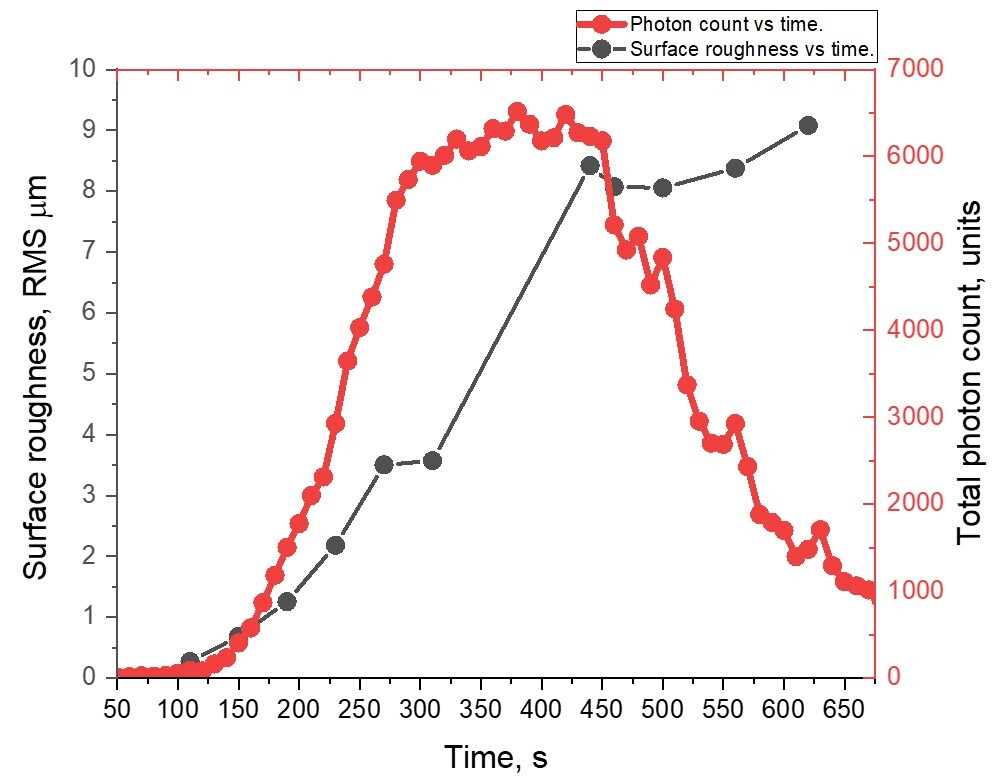
In this work a new generation arrangement is investigated. A rotating steel target was irradiated with a loosely (f=~2m) Ti:sapphire laser over a course of 5-15 minute intervals, during which X-ray photon count was measured every 10 s. The profile of the sample was measured at different points in time. The X-ray measurements were carried out with different parameters varied: pulse duration, sample position and pulse power. The measurements showed a rise in X-ray generation that coincides with the appearance of self-forming microstructures on the surface of the sample indicated by an increasing surface roughness (Fig 1). These structures are believed to act as local field enhancers and were found to amplify the X-ray radiance by up to ~1000 times. After a certain point generation drops and surface roughness ceases to increase, believed to be related to surface oxidation. Pulse duration measurements revealed that longer pulses yield better efficiency as higher intensity pulses get more attenuated by the plasma while the beam is propagating through air.
The obtained results suggest that laser induced X-ray sources can be further optimized to yield more efficient generation by introducing laser structured surfaces.